

It has been more than three years since I left Pakistan and returned to China. Since then, I have naturally spent more time following developments at home, but I still keep an eye on Pakistan when I can, especially news related to the China-Pakistan Economic Corridor (CPEC).
CPEC is often described as a flagship project under the Belt and Road Initiative. First proposed in 2013, it has now entered what China and Pakistan call the “2.0” stage.
Broadly speaking, compared with the first phase, CPEC 2.0 is expanding into areas that are less visible than the roads, power plants and ports that defined much of its earlier development.
A recent article published by a WeChat account called CPEC, titled “CPEC 2.0 Expands Into Marine Science and the Blue Economy,” caught my attention for exactly that reason.
When people think of CPEC, they are more likely to picture projects on land, whether infrastructure or industrial zones. So I found it interesting to see marine science and the blue economy becoming part of the conversation.
The immediate background is the China-South Asia Marine Cooperation Forum, held in Qingdao, east China’s Shandong Province, on September 17 and 18.
More than 100 government officials and experts from China, Pakistan, Sri Lanka, Bangladesh, the Maldives and other South Asian countries attended the forum. Participants adopted the China-South Asia Marine Cooperation Initiative, with a focus on marine science, sustainable development and the blue economy.
China Natural Resources News (《中国自然资源报》) also covered the event. Sun Shuxian, head of China’s State Oceanic Administration, said China was willing to work with South Asian countries to build a closer blue partnership and participate together in global ocean governance.
The CPEC article argues that marine science and the blue economy are emerging as part of CPEC 2.0, connecting Pakistan’s coastline and marine resources with research, technology, environmental management and regional cooperation.
Below is the full article.
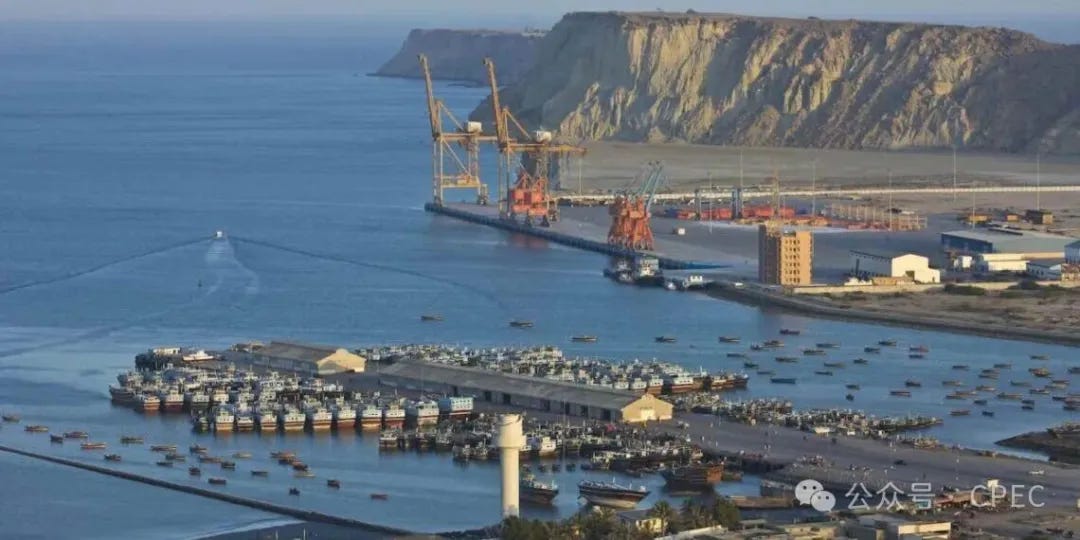
Pakistan has a coastline of around 1,000 kilometers and considerable room to develop its marine economy. Gwadar Port brings that potential directly into the CPEC framework.
Building China-Pakistan ties in marine science
The Qingdao forum focused on three main areas: ocean and climate observation, forecasting and disaster risk reduction; marine ecosystem protection and restoration; and integrated ocean management and the sustainable development of the blue economy.
Pakistani experts took part in the discussions, including representatives from the National Institute of Oceanography and Lasbela University of Agriculture, Water and Marine Sciences.
Dr. Abdul Malik, vice chancellor of Lasbela University of Agriculture, Water and Marine Sciences, highlighted Chinese support for Pakistan’s marine science capacity, particularly in talent training.
Other Pakistani participants pointed to opportunities in technology transfer, joint research and capacity building.
The forum was organized by the First Institute of Oceanography under China’s Ministry of Natural Resources. The institute said representatives from five South Asian countries, along with Chinese participants, attended the September meeting.
This provides a foundation for cooperation that goes beyond physical infrastructure and extends into knowledge and research capacity.
Why this matters for Gwadar
Gwadar Port gives the marine agenda a direct connection to CPEC.
The port is intended to form part of a broader connectivity and economic network. The CPEC Action Plan 2025-2029 calls for stronger cooperation in the marine economy, sustainable use of marine resources, marine research and environmental protection.
The action plan also calls for better connectivity between the New Gwadar International Airport and Gwadar Port, with the goal of developing Gwadar into a regional connectivity hub.
This means marine science can support CPEC in ways that are easy to overlook.
Better ocean observation can support marine planning. Marine research can strengthen environmental management. Better scientific knowledge can also support fisheries, aquaculture and other coastal economic activities.
The connection between research and commerce is therefore indirect, but important.
The blue economy is about more than fishing
The blue economy is often reduced to fisheries, but the concept is much broader.
It includes aquaculture, seafood processing, shipping, marine research, coastal tourism, environmental services, offshore resources, as well as technologies related to ocean monitoring and climate resilience.
Pakistan has already brought some of these areas into the CPEC 2.0 agenda.
At a business-to-business cooperation meeting organized by the CPEC Secretariat in April 2026, aquaculture and seafood processing were specifically identified as potential areas of cooperation.
The meeting also discussed industrial development and value-added processing in Gwadar.
This matters because there is a major difference between exporting basic marine products and building domestic capacity in processing, cold-chain logistics, packaging, certification and branded seafood products.
The latter can create considerably more economic value.
From ocean data to economic activity
One of the biggest potential contributions of marine science is information.
Fisheries and aquaculture depend on knowledge of marine ecosystems. Ports and shipping require reliable weather and ocean data. Coastal communities are affected by storms, flooding, erosion and changes in the marine environment.
That is why the Qingdao forum’s focus on observation, forecasting and disaster risk reduction has both environmental and economic value.
But scientific cooperation does not automatically translate into economic results.
Joint research projects, training and technical exchanges can build capacity. Turning that capacity into commercial output also requires institutions, investment, regulation and participation from the private sector.
A different form of CPEC 2.0
The first phase of CPEC was defined largely by major infrastructure and energy projects.
Pakistani officials have described the second phase as broader in scope, covering industry, agriculture, technology, mining, human capital and business-to-business cooperation.
Marine science fits naturally into that wider framework.
It can help build the knowledge base needed for coastal industries while also supporting environmental protection. It can also create more opportunities for Pakistani researchers and universities to work with Chinese institutions on challenges facing both countries.
This represents another form of connectivity, built through research networks, professional expertise and institutional cooperation rather than roads and other physical infrastructure alone.
Bringing Pakistan’s seas into its economic strategy
Pakistan has considerable marine potential, but potential does not automatically become economic output.
If the blue economy is to contribute more to growth, Pakistan will need stronger research capacity, better ocean data, more modern fisheries and aquaculture technology, cold-chain infrastructure, processing facilities, export standards and effective environmental regulation.
China can be a partner in this process, particularly through research cooperation, technical training and links between institutions.
For CPEC 2.0, this is where the longer-term value of marine cooperation may lie.
The next stage of China-Pakistan cooperation may no longer be measured only in kilometers of roads, electricity generated or cargo handled.
It could also be measured by researchers trained, scientific capacity built, marine resources managed more sustainably, and new industries developed along Pakistan’s coastline.
That is how the blue economy is beginning to enter the CPEC 2.0 story.
For readers interested in more on CPEC, the WeChat account South Asia Research Brief (南亚研究通讯) recently reposted an article titled “A Decade of CPEC: What Can Be Learned From Its Development Practices and Approaches to Risk?”
The piece originally appeared on the WeChat account Emei Mantan (峨眉漫谈). It offers a broader review of CPEC’s development and the risks and challenges it faces, using an approach increasingly common in Chinese policy discussions: looking at development and security together.