

Nearly three years have passed since Chinese authorities unveiled a plan in September 2023 to support its eastern Fujian Province in exploring new approaches for integrated development across the Taiwan Strait.
In March this year, Fujian released what it described as the first batch of milestone achievements in the construction of the cross-Strait integrated development demonstration zone. Among the achievements highlighted by the Fujian government was progress toward creating “same-city living circles” between Xiamen and Kinmen, and between Fuzhou and Matsu.
Having visited both Xiamen, the port city in Fujian, and Kinmen, a Taiwan-administered island group lying just off the mainland coast, I wanted to take a closer look at how integration between the two places has developed over the past three years.
This post was prompted by the recent 18th Straits Forum in Xiamen. Several side events focused on cooperation between Xiamen and Kinmen, bringing together officials, business representatives, researchers and residents familiar with developments on both sides. Journalist friends in Xiamen were therefore able to help me obtain some relatively detailed information about the projects now being pursued.
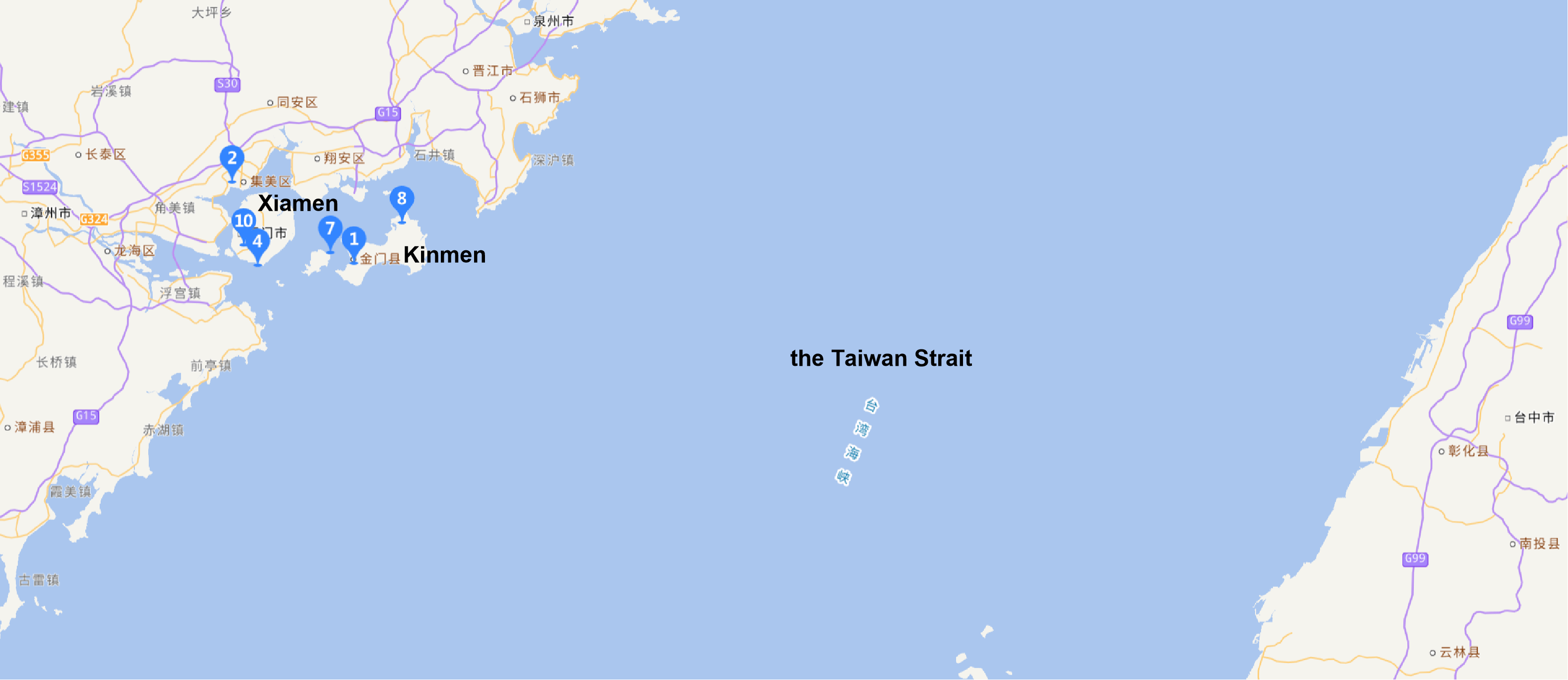
First, however, it is worth briefly considering the historical background. A line widely attributed to a Qing-dynasty edition of the Taiwan gazetteer compared Taiwan and Xiamen to “the two wings of a bird,” adding that local people regarded the two as closely interconnected.
The historical relationship was also examined in Xiamen’s Economic and Social Development Strategy, 1985–2000 (《1985年——2000年厦门经济社会发展战略》 ), a long-term development study prepared in the 1980s. The book discussed the movement of people and goods between Xiamen and Taiwan and the importance of those connections to Xiamen’s development.
What, then, has made the relationship between Xiamen and Kinmen a testing ground for cross-Strait integration?
More than two decades ago, limited direct postal, trade and transport links were established between Fujian and the Taiwan-administered offshore islands of Kinmen and Matsu. These arrangements became known as the “mini three links (“小三通”),” as distinct from the broader postal, trade and transport links established across the Taiwan Strait.
On Jan. 2, 2019, at a meeting marking the 40th anniversary of the Message to Compatriots in Taiwan, the Chinese leadership called for smoother economic and trade cooperation, infrastructure connectivity, the sharing of energy and resources, and the alignment of industry standards across the Strait. These proposals became known as the “new four links (“新四通“).”
The Chinese leadership also proposed that Kinmen and Matsu could take the lead in establishing direct links with nearby parts of Fujian in four specific areas: water, electricity, gas and bridges. These are commonly referred to on the mainland as the “mini four links.”
Kinmen, together with Xiamen and other coastal areas of Fujian, has therefore served as a testing ground for broader forms of cross-Strait integration.
The Chinese mainland has continued to promote this approach. In April 2026, the mainland rolled out a package of 10 policies and measures -- spanning inter-party communication, infrastructure, travel, trade and culture -- aimed at boosting exchanges and cooperation with Taiwan. They included renewed support for water, electricity, gas and bridge connections between coastal Fujian and Kinmen and Matsu, as well as a proposal allowing Kinmen residents to make use of Xiamen’s new airport.
The connections already in operation
How much integration between Xiamen and Kinmen currently exists in practice?
The passenger ferry offers one of the clearest indicators.
Ten vessels currently operate on the Xiamen–Kinmen route, with 24 sailings each day. The one-way journey takes about 30 minutes. According to data from the Xiamen General Station of Exit and Entry Frontier Inspection, annual passenger journeys on the route rose sharply over the past three years:
710,000 in 2023
1.25 million in 2024
1.74 million in 2025
These are passenger journeys rather than the number of unique travelers, meaning that a person making a round trip is normally counted twice. Even so, the figures show a substantial recovery and expansion of cross-Strait movement through the route.
Among the proposed water, electricity, gas and bridge connections, water is by far the most advanced.
Fujian began supplying water to Kinmen on August 5, 2018. According to Fujian Water Resources Investment & Development Group, Fujian has since supplied Kinmen with more than 49 million tonnes of water. Daily deliveries now stand at about 21,000 tonnes, accounting for approximately 87 percent of the water handled by Kinmen’s public water system.
When I was reporting in Kinmen earlier this year, I met Zhang Yangyang, a Kinmen native who moved to Xiamen in 2009 to study traditional Chinese medicine at Xiamen University. He recalled that water shortages were once a defining feature of everyday life for a generation of Kinmen residents.
“I remember that when I was a child, the water would sometimes be cut off, and we had to take storage containers and wait for water,” he said. “That no longer happens.”
Integration has also extended into selected areas of public services.
Xiamen has made school and kindergarten places available to children from Kinmen, with preferential policies applying at different stages of education. It has encouraged Kinmen residents to seek employment in the city and offers certain subsidies to qualifying companies that recruit talent from Kinmen.
Kinmen residents working or living in Xiamen may also be eligible for employee medical insurance, temporary assistance and a range of basic public-health services, including health records and vaccinations. Some can apply for public rental housing or subsidized housing.
These policies represent an effort to incorporate Kinmen residents into parts of Xiamen’s public service system.
Infrastructure prepared on one side
The remaining three elements of the “mini four links” — electricity, gas and a bridge — have made some progress on the Xiamen side, but none has yet resulted in a functioning connection across the water.
On electricity, the supporting alternating-current grid on the mainland side has been put into operation, while preparatory procedures for a planned converter station have been completed.
Academic and technical discussions on connecting the Xiamen and Kinmen power grids have taken place several times since 2020. The two power systems operate at different frequencies, so the proposed link would use a flexible direct-current conversion system in Xiamen to make the electricity compatible with Kinmen’s grid before sending it across the water by subsea cable.
According to people familiar with the project, there are no fundamental technical obstacles, but the main difficulty is the Taiwan authorities’ refusal to engage in direct communication.
Taiwan authorities have questioned whether such a connection is necessary. In August 2022, Taiwan’s Mainland Affairs Council said that linking the power grids would involve the exercise of public authority by both sides and that no consultations had taken place. It added that, according to an assessment by Taiwan Power Company, existing generating capacity could meet projected growth in demand in Kinmen and Matsu for another decade. It therefore saw neither an urgent need nor an immediate necessity for a connection with Fujian.
On gas, an LNG supply station and part of the related pipeline network have been built on the Xiamen side. According to the Xiamen Municipal Bureau of Municipal Administration and Landscape, Taiwan authorities have not formally responded to the proposal for a Xiamen–Kinmen gas link, while the Kinmen county government has expressed support.
Regarding the proposed bridge, which is probably the most visible one of the projects, the Xiamen section of the Xiamen-Kinmen Bridge project is scheduled to open by the end of this year, and the project serves to link Xiamen island to Xiang’an International Airport and includes a reserved interface for a future extension to Kinmen. Taiwan authorities have not announced a corresponding construction plan on the Kinmen side.
Kinmen residents have told me that flights at Kinmen Airport are sometimes delayed or cancelled because of fog. In their view, access to the much larger airport in Xiamen could provide an alternative route when weather disrupts local services.
For Kinmen passengers to use the airport through a dedicated arrangement, the two sides would need to address immigration controls, customs procedures, transport links, aviation regulation and security responsibilities.
Why did water come first?
The contrast among the four projects raises an obvious question: why was water supply implemented while electricity, gas and a bridge remain incomplete?
Yang Kunfu, a council member of Xiamen Association for Taiwan Studies, argues that the main reason was the severity of Kinmen’s water shortage. A shortage of fresh water presented an immediate and widely recognized public need.
Compared with electricity, gas or a bridge, the water project also involved relatively straightforward engineering and was regarded as less politically sensitive. A bridge, by contrast, would have considerable symbolic as well as practical significance, making it much more difficult to advance in Taiwan’s current political environment.
Yang believes the four projects therefore need to proceed gradually, beginning with those that are easier to implement.
His explanation points to a broader distinction among the projects. Water, electricity, gas, a bridge and shared airport access are not one-off transactions. Each would create a long-term relationship involving investment, pricing, maintenance, emergency arrangements, regulation, security and the allocation of responsibility.
Infrastructure can be prepared by one side alone. A functioning cross-boundary connection cannot.
There is also a difference between local support and the authority to implement a project. The Kinmen county government and some local political and business figures have expressed support for deeper links with Xiamen. But decisions involving electricity, energy, cross-boundary roads, immigration and customs cannot be made by Kinmen alone.