


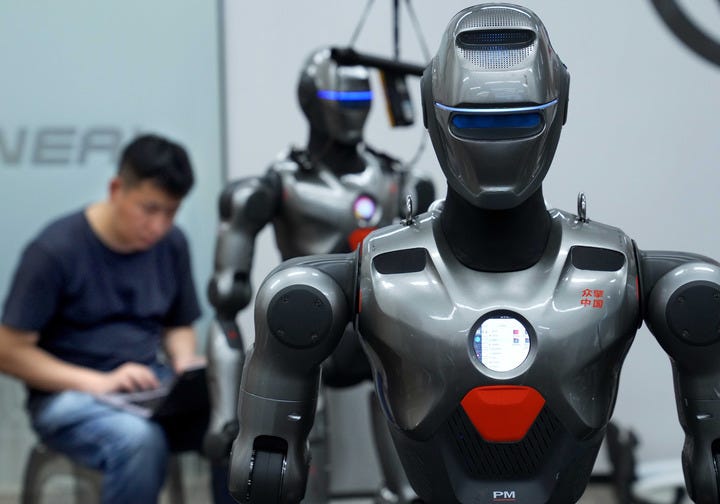
On Wednesday, Unitree Robotics made its trading debut on the Shanghai Stock Exchange’s sci-tech innovation board, or STAR Market. Shares in China’s best-known humanoid robot maker surged more than 400 percent from their IPO price by the close, after climbing even higher earlier in the day. The company raised about 900 million U.S. dollars in the offering.
Chinese robotics companies are also gaining ground overseas. Data from the General Administration of Customs on China’s goods trade for the first half of the year highlighted some remarkable figures: exports of industrial robots reached 6.29 billion yuan (about 936 million U.S. dollars), up 18.6%, reaching 141 countries and regions; surgical robot exports surged to 480 million yuan, a 3.3-fold increase; and combined exports of cleaning robots and smart bionic robots totaled 18.09 billion yuan.
Robotics is one of several Chinese technology stories drawing attention this summer.
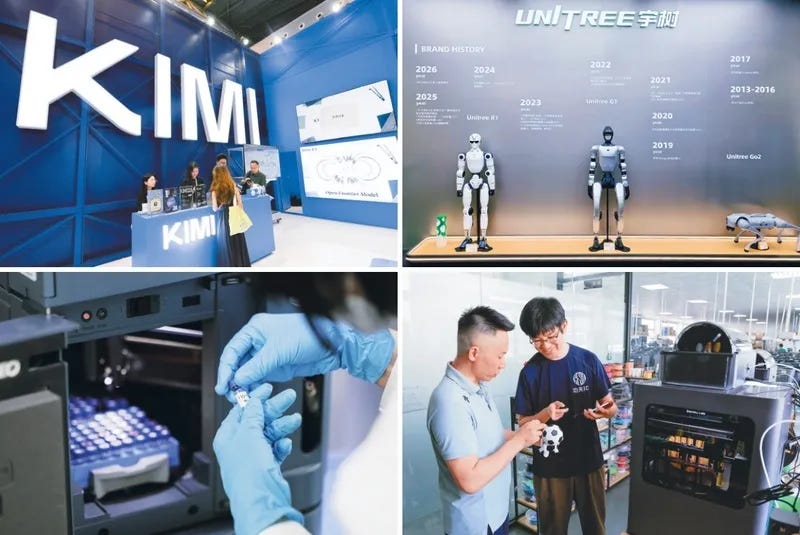
A month earlier, Beijing-based Moonshot AI released Kimi K3, a 2.8-trillion-parameter open-weight model with a one-million-token context window. Its release drew attention well beyond China, adding to a broader debate over the growing presence of Chinese models in the global open-weight AI ecosystem.
By Executive President of China Finance 40 Forum (CF40) Institute Guo Kai‘s estimation, the AI supply chain now accounts for 22% of China’s total exports and contributes to roughly half of the export growth. Guo noted that large-scale investment in the overseas AI industry continues to drive China’s exports of high-end hardware, computing infrastructure and related products.
(I know the figure that AI-related supply chains account for 22% of China’s exports sounds a little startling. I was skeptical when I first saw it too. But more than one expert has cited a similar estimate, so I checked with someone in the industry who works closely with the data. The answer I got was that the figure is indeed roughly on that scale. Optical transceiver companies, for example, are now among the major contributors to export growth.)
A similar shift is visible in China’s biotech sector. Overseas licensing deals involving Chinese innovative drugs exceeded 100 billion U.S. dollars in total potential value in the first half of 2026, setting a new record, according to China’s Ministry of Industry and Information Technology (MIIT).
In May 2026, Hengrui Medicine, headquartered in eastern Chinese city of Lianyungang, and Bristol Myers Squibb (BMS), an American multinational pharmaceutical company, announced a landmark global partnership to co-develop 13 early-stage programs across oncology, hematology and immunology.
These three sectors — robotics, artificial intelligence and innovative drugs — have recently been grouped together in China under a new label: the “New New Trio” (新“新三样”).
The comparison is easy to see. China’s previous “New Trio” of electric vehicles, lithium batteries and solar products became symbols of the country’s industrial rise in the first half of this decade. By 2025, “New Trio” exports neared 1.3 trillion yuan, a 3.5-fold increase from 2020, according to the General Administration of Customs of China (GACC).
Yet the analogy only goes so far. Robots can be counted at customs. AI models can spread through downloadable weights and APIs. Drugmakers can license molecules overseas years before a finished medicine reaches the market. Together, these sectors point to a broader change in how Chinese industrial capabilities are reaching the world: through software, intellectual property, research and production systems as well as manufactured goods.
Why Are These Sectors Emerging Together?
Robotics, AI and innovative drugs may look like three separate stories. Their routes overseas are certainly different. But their rise at roughly the same time is not entirely coincidental.
In robotics, Chinese companies are drawing on capabilities already built at scale in industries such as electric vehicles and consumer electronics. Batteries, motors, sensors, power electronics, machine vision and control systems are all important to both EVs and robots. It is no surprise that Chinese automakers such as BYD and XPeng are also developing humanoid robots.
AI adds another layer. Chinese companies are competing in foundation models, but the industry also rests on a much larger network of servers, data centers, communications infrastructure and power systems. The models can in turn feed back into manufacturing, robotics and scientific research. The recent overseas attention around Kimi and other Chinese open-weight models shows how some of these capabilities can reach international users without taking the form of a physical export.
Biotech has followed a different path, but it also benefits from accumulated capabilities elsewhere in the economy: China’s chemical industry, clinical research resources, engineering talent and growing computing capacity. The surge in overseas licensing deals shows that Chinese pharmaceutical companies are increasingly able to sell research assets and intellectual property, rather than simply manufacture drugs developed elsewhere.
These links point to a deeper explanation for why several internationally competitive Chinese industries are emerging together: China’s industrial system has become denser and more interconnected.
For decades, the advantage of having a broad manufacturing base was largely associated with scale and cost. Today, another advantage is becoming more visible. Technologies, supplier networks and production know-how developed in one industry can be reused in another, while engineers and technical talent can move across sectors.
The EV industry helped build supply chains that robotics companies can tap. Advances in AI can be applied to robots, factories and drug discovery. Computing infrastructure built for the digital economy can support both industrial automation and scientific research.
China therefore does not have to build every new industry entirely from scratch. New sectors inherit part of the infrastructure, talent and technical knowledge accumulated by the ones that came before them.
That helps explain both the number of new industries appearing and the speed at which some Chinese companies are reaching the global market.
From the “Old Three” to the “New New Trio”
The familiar Chinese labels offer a useful way to trace the change. The so-called “Old Three” of clothing, furniture and home appliances represented the classic export model of the 1990s and early 2000s. Global demand was already well established. China combined low labor costs, foreign investment, processing trade and increasingly efficient manufacturing to supply it at enormous scale.
The “New Trio” of EVs, batteries and solar products followed a different path. Demand for cleaner energy and transport was growing, but high costs still limited adoption. China’s domestic market, supply chains and manufacturing scale helped bring those costs down.
The industries now described as the “New New Trio” are emerging at an earlier stage of market development. Their end markets, business models and technology paths are still taking shape, yet Chinese companies have already become serious players.
Their eventual positions remain uncertain. What has changed is the timing. Chinese companies are entering these industries earlier, with a greater role in shaping how technologies are developed and commercialized.
Beyond containers
The older export story was relatively easy to measure. Factories made goods, ships carried them abroad, and customs recorded the value.
That picture becomes less complete as technology and intellectual property account for more of the value being created. Trade statistics capture only part of the international reach of the “New New Trio.”
Commercial relationships are also becoming more intertwined. A foreign company may use Chinese technology in its own products while competing with Chinese firms elsewhere. A global pharmaceutical company can license Chinese drug candidates to strengthen its pipeline. Similar overlaps are emerging in AI and advanced manufacturing, making the line between customer, supplier, partner and competitor less clear than in traditional merchandise trade.
China’s domestic market is an important part of this process. Rising labor costs are creating demand for automation, an aging population is putting pressure on health care, and companies across the economy are experimenting with AI to improve productivity. These pressures give emerging technologies a large market in which to be tested and refined.
China’s latest five-year plan reinforces that direction, placing AI, embodied intelligence, biomedicine and other emerging technologies high on the industrial agenda:
瞄准引领未来发展重点领域,构建未来产业全链条培育体系,推动量子科技、生物制造、氢能和核聚变能、脑机接口、具身智能、第六代移动通信等成为新的经济增长点。
Targeting key areas that will shape future development, China will build a full-chain system to foster future industries and promote quantum technology, biomanufacturing, hydrogen and nuclear fusion energy, brain-computer interfaces, embodied intelligence, sixth-generation mobile communications and other fields as new drivers of economic growth.
Overseas expansion is increasingly built on this domestic base. Chinese companies can improve products at home, build scale and then reach foreign users through several routes, including direct sales, licensing and technology platforms. This differs from the older model of factories built mainly to serve overseas orders.
进一步引导和规范企业境外投资方向,支持有条件的企业开展互利共赢的境外投资合作,鼓励互联网平台、人工智能等新兴产业企业拓展海外应用场景。
Further guide and regulate the direction of enterprises’ outbound investment, support qualified enterprises in carrying out mutually beneficial overseas investment cooperation, and encourage companies in emerging industries such as internet platforms and artificial intelligence to expand their applications and use cases overseas. -- China’s national 15th Five-Year Plan
Will there be another “China Shock”?
Whether the global expansion of these industries will produce another “China shock” is still too early to tell. Their technologies, business models and routes overseas differ considerably from the manufactured exports that defined earlier waves of China’s industrial rise.
What is already visible, however, is a more cautious response in some countries as Chinese companies expand into these sectors. The U.S. Federal Communications Commission has introduced restrictions affecting certain foreign-made advanced robots. In Washington, the growing capabilities and low cost of Chinese open-weight AI models have also raised questions about cybersecurity, technological dependence and the strength of American alternatives.
Such resistance does not appear to be unexpected in China. Discussion of the “New New Trio” combines optimism about their growth with caution about the external environment they may face. On Wednesday, the CPC journal Qiushi reposted an article titled “The ‘New New Trio’ Is Reshaping China’s Development Logic” from Southern Daily, warning that technology restrictions, patent barriers, trade protection and higher overseas market-access thresholds could become increasingly important constraints:
从外部环境看,全球科技竞争日趋激烈,部分国家实施技术打压、专利限制、贸易保护政策,人工智能、生物医药、高端装备领域技术封锁加剧,海外市场准入门槛持续抬高。
From the external environment, global competition in science and technology is becoming more intense. Some countries have introduced technology restrictions, patent constraints and trade protection measures. Barriers are also rising in areas such as artificial intelligence, biomedicine and high-end equipment, making access to overseas markets more difficult.
从产业自身看,部分高端核心元器件、底层算力芯片、高端医疗设备材料仍存在短板,顶尖基础人才供给不足,中小企业创新转化能力偏弱,产学研深度融合机制仍需完善。
Within the industries themselves, gaps remain in some high-end core components, foundational computing chips, and advanced materials for medical equipment. There is also a shortage of top-tier talent in basic research, while small and medium-sized enterprises remain relatively weak in turning innovation into commercial applications. Closer integration among industry, universities and research institutions is still needed.
从行业生态看,人工智能伦理监管、生物医药国际审批、机器人行业全球统一标准等规则体系建设,仍滞后于产业扩张速度。
At the industry ecosystem level, rulemaking has not kept pace with market expansion in areas such as AI ethics and regulation, international approval of biopharmaceutical products, and globally harmonized standards for the robotics industry. -- Southern Daily
To address these challenges, the article proposes two responses: “strengthening weak links in the industrial chain and building an independent, controllable, secure and efficient science and technology innovation industrial chain,” and “improving the industrial ecosystem, facilitating the commercialization and application of scientific and technological achievements, and taking a more active role in shaping global rules for science and technology.” Both priorities are also written into China’s 15th Five-Year Plan.
The article concludes by spelling out the respective roles of the “old three,” the “new trio,” and the “New New Trio” in China’s development:
“老三样”承载稳定就业、保障民生供给,数字化改造后向功能性、高端化转型,持续稳住外贸基本盘;“新三样”依托成熟绿色产业链,持续扩大全球领先优势,夯实绿色发展底座;“新新三样”作为未来产业先导,带动全行业智能化、高端化升级,为传统产业转型提供技术工具。
The “Old Three” continue to support stable employment and meet everyday needs. With digital upgrading, they are moving toward higher-end and more specialized products while helping anchor China’s foreign trade. The “New Trio,” backed by mature green-industry supply chains, continue to strengthen their global competitiveness and provide a foundation for green development. As emerging industries, the “New New Trio” can help drive smarter and higher-end development across the economy and provide new technological tools for the transformation of traditional industries.
Given that the industries grouped under the “New New Trio” are still at an early stage, it may take more time before we can see the full picture. Commercial aerospace, quantum technology, low-altitude aviation and other sectors could eventually join this group of globally competitive industries. Will we one day be talking about a “New New New Trio”? Or perhaps some of them are already taking shape around us.
China’s gaming industry is another sector I would put on the watchlist. After Black Myth: Wukong made a considerable impact overseas in 2024, I was curious about how far that success had actually reached beyond Chinese and overseas Chinese players. So I asked ChatGPT to look at the available data. Its conclusion was that Black Myth: Wukong had not become “a mass cultural phenomenon in Europe and the United States,” but it had “become a mainstream title among core gamers worldwide.” That is already a fairly high bar to clear.
So I will end this article with the 15-minute gameplay demo of Black Myth: Zhong Kui, the new title from the studio behind Black Myth: Wukong, released on Thursday. I would also be very interested to hear what you think of the game. If you’re short on time, you can just watch the final minute. The first 14 minutes stay with a few longer sequences, while the last minute cuts quickly across many more settings and scenes from the game.