


Good evening. Today, we’re discussing French President Emmanuel Macron’s latest state visit to China.
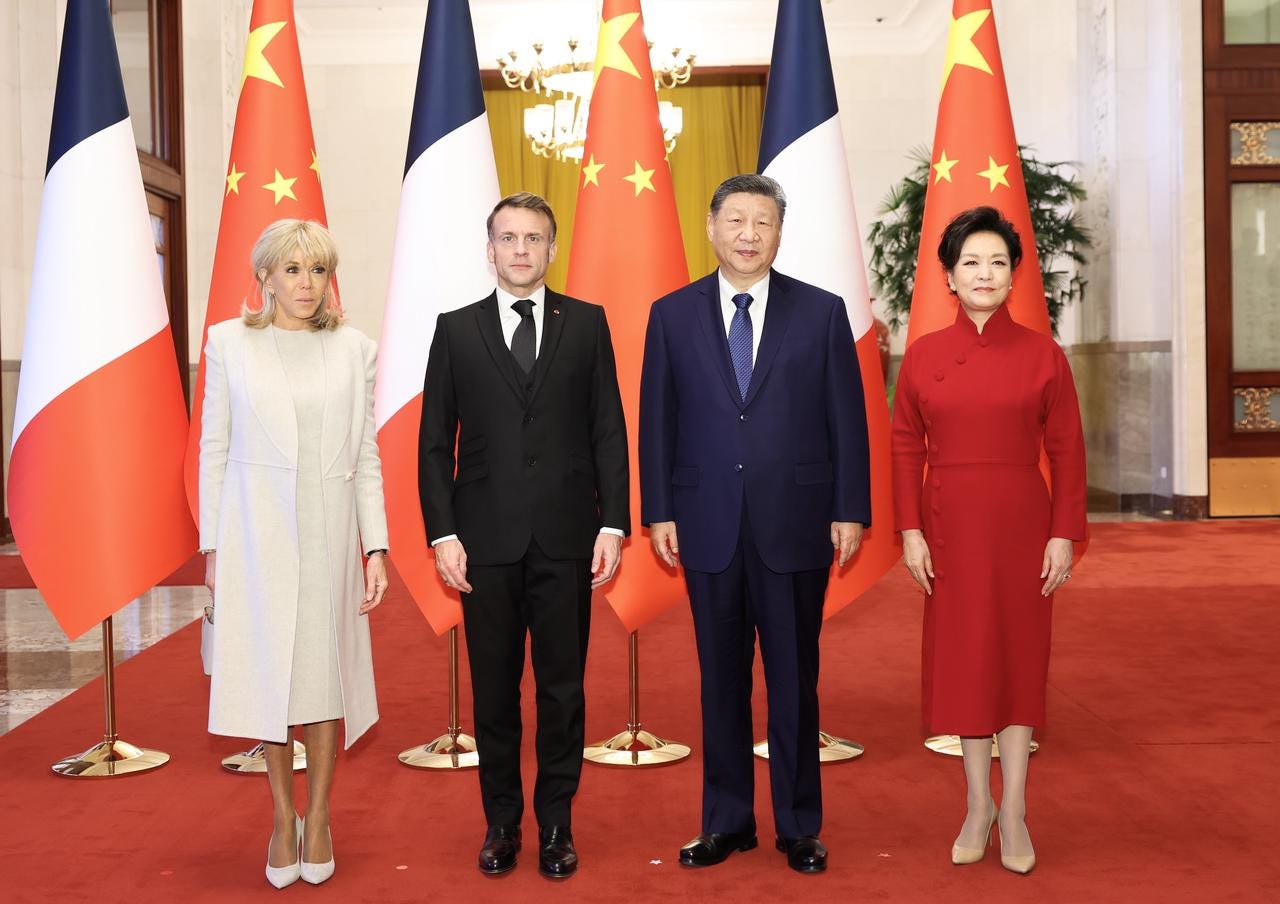
It was Macron’s first visit to China since 2023 and his fourth state visit to China as French president. High on his agenda are economic issues such as bilateral trade and investment. Macron left for China just one day after he met the Ukrainian President Volodymyr Zelenskyy in Paris, and as expected, he and Chinese President Xi Jinping discussed the Russia-Ukraine conflict.
BEIJING AND CHENGDU -- A TALE OF TWO CITIES
Macron and his wife Brigitte arrived in Beijing on Dec. 3, where he was greeted at the airport by Chinese Foreign Minister Wang Yi, who travelled to France days earlier to arrange this trip.
On Dec. 4, Xi Jinping and his wife, Peng Liyuan, held a welcome ceremony for Macron and Brigitte Macron. The two leaders then held talks and oversaw the signing of a range of cooperation documents covering nuclear energy, agriculture, food, education, and ecological environment. Following their discussions, they addressed the press together.
Later the same day, Xi and Macron attended the closing ceremony of the seventh meeting of the China-France Business Council. Macron also met with Chinese Premier Li Qiang, and Zhao Leji, China’s top legislator, on Thursday.
In the evening, the French presidential couple traveled to Chengdu, capital of southwest China’s Sichuan Province. The city of Chengdu, which established a sister-city relationship with Montpellier in 1981, holds historical significance as the first such partnership between the two countries.
Chengdu is also home to a research base of giant panda breeding, where a famous pair of giant pandas is undergoing quarantine after returning last month from France. The pair is retiring after spending more than a decade at ZooParc de Beauval.
On Dec. 5, Macron and his wife visited Dujiangyan, a 2,200-year-old irrigation system in Chengdu that made the local area a major grain-producing area and a “Land of Abundance” (天府之国), which continues to function to this day.
At the irrigation system site, Xi said ancient engineers of this irrigation system tailored measures to local conditions (因地制宜) and designed in harmony with the natural flow of water (顺势而为). Xi told Macron that this spirit can be used in many other fields. “We can draw inspiration for governing the country from this ancient wisdom and make sound decisions.”
It is worth noting that during a single state visit, President Macron held two separate meetings with President Xi Jinping in two different Chinese cities — an arrangement that is relatively uncommon and has drawn attention.
In recent years, a notable feature of interactions between Xi and Macron has been their efforts to broaden their exchanges beyond the capitals of their respective countries. In 2023, Macron traveled to Guangzhou, where he enjoyed a performance of the ancient Guqin melody “High Mountain and Flowing Water.” The following year, at Macron’s invitation, Xi traveled to the Hautes-Pyrénées department in France.
Shortly before returning to France, Macron also delivered a speech at Sichuan University and played table tennis with players from both countries, including Chinese world champions. He was spotted running around a lake in Chengdu on that morning and greeted local citizens. His encounters with cheering Chengdu locals later went viral on Chinese social media, showing crowds rushing to shake hands and take selfies with the French president -- a warmth and spontaneity that Macron himself might find increasingly rare in Paris.
On Friday, Brigitte visited the giant panda research and breeding base in Chengdu, where she was reunited with Yuan Meng, a panda born in France and named by the French first lady, who serves as his godmother.
During Macron’s stay in China, the two sides issued joint statements on global governance, climate and environmental challenges, nuclear energy, agriculture and food, and the situations in Ukraine and Palestine.
Notably, their statement on global governance introduces a new narrative regarding the international system -- one based on international law and rules of solidarity (基于国际法及团结规则的国际体系). This reminds people of the so-called “rules-based international order” long promoted by the United States. While the term “rules-based” sounds palatable to the ears, in practice, the U.S. takes liberty in interpreting what those “rules” actually entail.
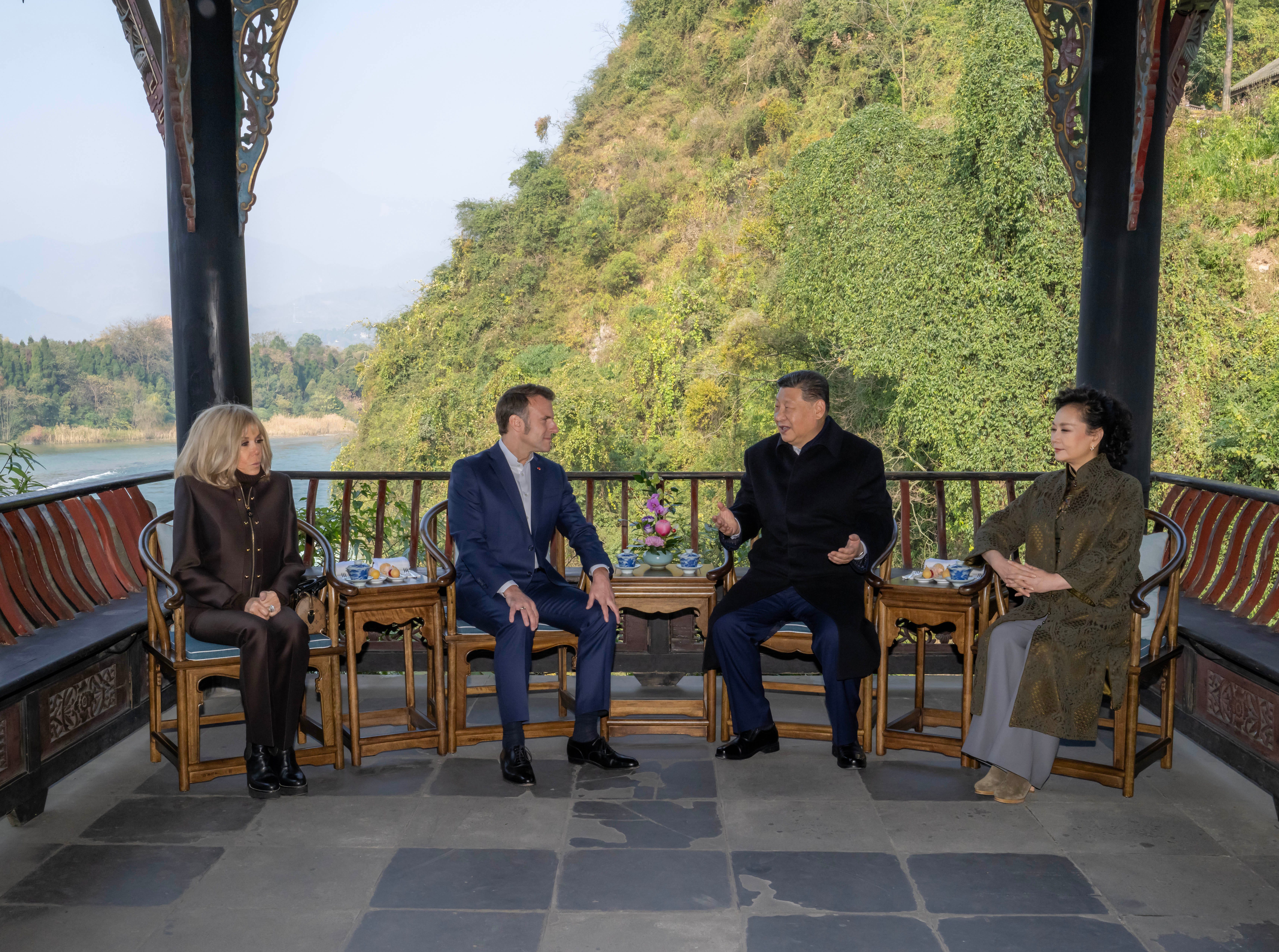
The two couples at Dujiangyan, Chengdu City. (Xinhua)
SUBSTANTIVE, DETAILED PRESS READOUT
The most closely watched events of Macron’s visit included his talks with President Xi on Thursday, their joint press appearances, and speeches to both Chinese and French entrepreneurs. Xinhua News Agency released three detailed reports on these events. Below are the key points made by the two world leaders during their interactions.
*During his talks with Macron, Xi described China and France as independent, visionary and responsible major countries (有远见、有担当的独立自主大国). The two countries should demonstrate a sense of responsibility, uphold multilateralism, and stand firmly on the right side of history, he said.
*Xi encouraged the two countries to consolidate cooperation in traditional fields such as aviation, aerospace and nuclear energy, while tapping into the potential for cooperation in areas including the green economy, digital economy, biopharmaceuticals, artificial intelligence and new energy.
*China is willing to import more high-quality French products, welcomes more French enterprises to develop in China, and also hopes that France will provide a fair environment and stable conditions for Chinese enterprise, he added.
*China and France should practice true multilateralism, and uphold the UN-centered international system and the international order underpinned by international law, said Xi.
*Citing the interconnectedness of global industrial and supply chains, Xi emphasized that openness and cooperation will bring opportunities for development, while decoupling and severing supply chains will lead to isolation.
*Macron said France firmly upholds the one-China policy. It is ready to work with China to promote mutual investment, strengthen cooperation in such areas as economy, trade and renewable energy, and deepen friendly cultural exchanges.
*Given the global geopolitical instability and challenges to the multilateral order, cooperation between France and China is even more important and indispensable, said Macron.
*On Ukraine, Xi said China supports all efforts that are conducive to peace and will continue to play a constructive role in the political settlement of the crisis in its own way. He said China supports European countries in playing their due role toward the establishment of a balanced, effective and sustainable European security architecture.
*When meeting with the press, Xi revealed that the two leaders agreed to enhance political mutual trust, expand practical cooperation, promote people-to-people and cultural exchanges, and advance the reform and improvement of global governance.
*It is hoped that all parties can reach a fair, lasting and binding peace deal that is accepted by all parties involved through dialogue and negotiation, Xi told journalists on the spot. He also added that China will continue to play a constructive role in the political settlement of the crisis, while firmly opposing any irresponsible actions that shift blame or distort the situation.
*When addressing Chinese and French entrepreneurs in Beijing, Xi called on the two countries to collaborate in reforming and improving global governance. During the Shanghai Cooperation Organization 2025 Summit, held in Tianjin from late August to early September, Xi put forward the Global Governance Initiative. Macron told Xi during their talks that France fully endorses President Xi Jinping’s proposals for reforming and improving global governance and promoting a more balanced global economy.
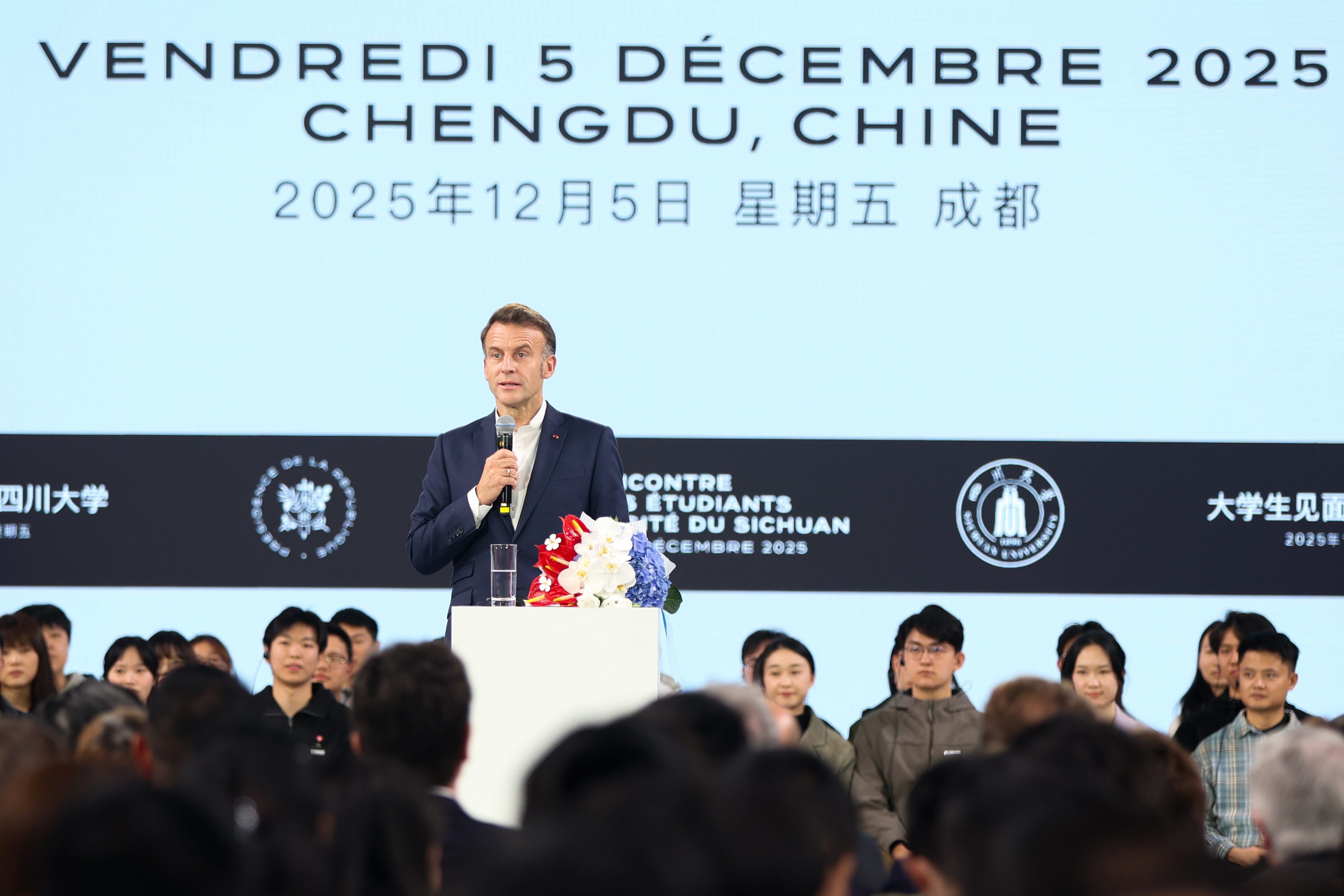
Macron speaks at Sichuan University, Chengdu (Xinhua)
TRADE, TRUST AND BEYOND
Beyond the immediate discussions on tariffs and trade, Macron’s visit revealed deeper layers of engagement -- a mutual quest for trust, investment reciprocity, and a shared vision for a multipolar world.
Zhao Yongsheng, professor from Beijing-based University of International Business and Economics and visiting scholar at Sorbonne University in Paris, told us that Macron’s visit was characterized by a high level of welcome and hospitality, widely regarded as “treatment of the highest caliber.” This reflects China’s strong emphasis on its relations with France and suggests that France may represent interests beyond its own on certain issues.
Analysts say France holds special value to China today, as it poses a notable challenge when the U.S. seeks Western leadership. In its foreign policy, China emphasizes rationalism and realism, always considering the bigger picture. The country handles trade disputes, such as those over electric vehicles, on a case-by-case basis, while its overall diplomatic framework, including France’s role, remains steady and unshaken.
Macron is a passionate advocate for European strategic autonomy and is trying to play a leading role in the EU after Angela Merkel’s retirement. Although trade is an EU competence, China hopes that France can do more for Beijing’s relations with Brussels, both on economic and political issues.
The core focus of the visit remained on economic and trade cooperation, as planned. A key new concept introduced during the discussions was Macron’s proposal to “promote mutual investment,” a formulation explicitly put forward for the first time. Zhao suggested that the emphasis lies particularly on increasing Chinese investment in France and the EU.
To achieve such mutual growth in investment, a critical obstacle remains the currently stalled EU-China Comprehensive Agreement on Investment (CAI) since 2021. It is speculated that the two sides may have discussed the possibility of France persuading other EU member states to resume negotiations on the agreement, according to Zhao.
French media observed a historical reversal: for four decades, technology had predominantly flowed from Europe to China. Today, Beijing ships electric vehicles, solar panels, batteries, and electronic components to Europe -- in other words, everything Europe needs to succeed in its energy transition. France is seeking technology transfers from China, said BFMTV.
Prof. Philippe Aghion, the 2025 Nobel laureate in economics, said, “Europe is still ahead of China in terms of research publications. We have very good researchers, but we do not always have the means to translate that research into breakthrough innovations. China, however, knows how to innovate. So the Chinese may well be interested in collaborations.”
Ukraine did not appear to be a central focus of Macron’s visit to China. Meanwhile, on trade frictions between the two sides — including the EU’s tariffs on Chinese electric vehicles, a move in which France played a role, and China’s retaliatory anti-dumping measures on EU cognac — there has so far been no clear indication of a breakthrough.
Zhao believed that the visit held multi-layered significance. It is expected to advance China-EU relations positively, with Macron serving as an important channel for high-level dialogue on behalf of the EU.
Yin Jianlong, director of the European Union Studies Center at Anhui University, said that both France and the EU need to bolster their credibility in dealings with China, in a veiled reference to Macron’s support for EU tariffs on Chinese electric vehicles. Macron’s visit, he said, was essentially an attempt at self-preservation, aimed at strengthening France’s ties with China amid a challenging international environment for both France and the European Union.
At a strategic level, amid a U.S. tilt toward unilateralism, China and France jointly reaffirmed their commitment to multilateralism. Moreover, their preference for resolving disputes through consultation -- rather than threats or sanctions -- offers a constructive model for global trade conflict resolution.
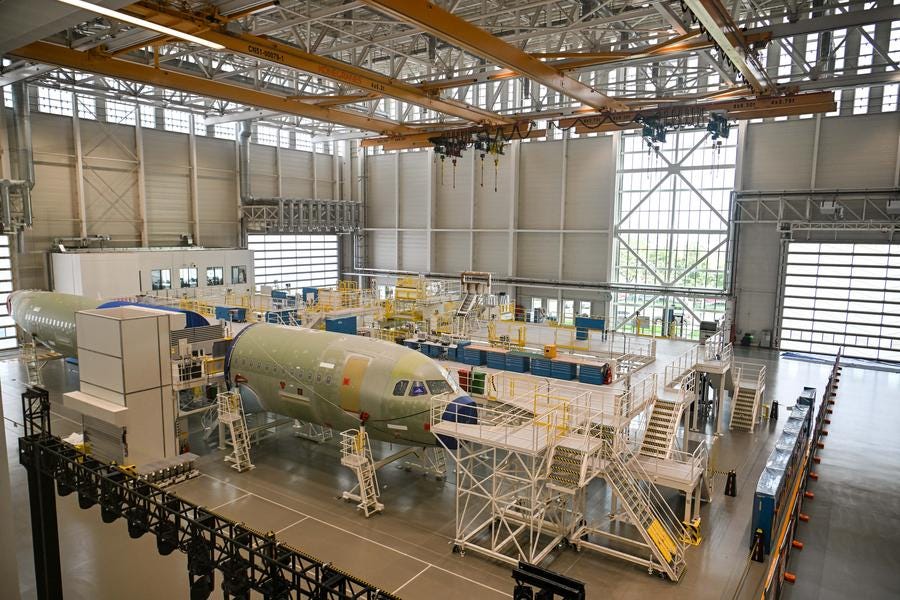
Airbus’s second Final Assembly Line for A320 family aircraft in Tianjin, China, is an icon of China-France cooperation (Xinhua)


Always funny to hear western countries seeking technology transfers from China XD