

Editor’s note:
Hello and welcome to “Big Argument,” a commentary column in Beijing Scroll that takes a different look at major debates involving China, especially where perspectives from China are missing or underrepresented in mainstream international coverage.
Some of the views in this article may differ from those more commonly encountered in Western media and policy discussions. But hearing arguments you may not encounter elsewhere is also part of the reason many of you read this newsletter.
Much of the international discussion about the Taiwan Strait begins with the possibility of war. Attention tends to focus on military drills, defense budgets, arms sales to Taiwan and whether the United States would intervene if conflict broke out.
By comparison, far less attention is paid to the shortage of regular communication and people-to-people contact across the Strait.
Since the Democratic Progressive Party (DPP) returned to power in 2016, official cross-Strait communication has largely broken down. The DPP’s party platform still retains the goal of “establishing the Republic of Taiwan as a sovereign, independent, and autonomous nation.” Beijing has accused both Tsai Ing-wen and Lai Ching-te of working with external forces to advance separatist “Taiwan independence” goals.
It argues that Lai’s remarks since taking office — including his statement that “Republic of China (ROC) and the People’s Republic of China (PRC) are not subordinate to each other” and his description of China as a “foreign hostile force” — have made that position more explicit, and has criticized his approach as a new “two states” theory.
The 1992 Consensus emerged in the early 1990s as the political formula that made cross-Strait dialogue possible. The DPP rejects that framework, while Beijing insists that official talks cannot resume without it. This disagreement over the basic political premise for dialogue has left the two sides without stable official channels through which to manage disputes and pursue peace.
The Chinese Kuomintang (KMT) party, led by Cheng Li-wun, has spent much of the first half of 2026 trying to fill part of that gap.
In April, Cheng led a KMT delegation to the mainland, becoming the first sitting party chair to make such a visit in about a decade. The trip also produced the first meeting between the leaders of the KMT and the Communist Party of China (CPC) in ten years. During the six-day visit, she met the CPC leadership and also visited companies, ports, local governments and historical and cultural sites.
Her message was straightforward: Taiwan should not become another crisis in an already unsettled world. The two sides should rebuild trust and give people more opportunities to travel, meet and interact.
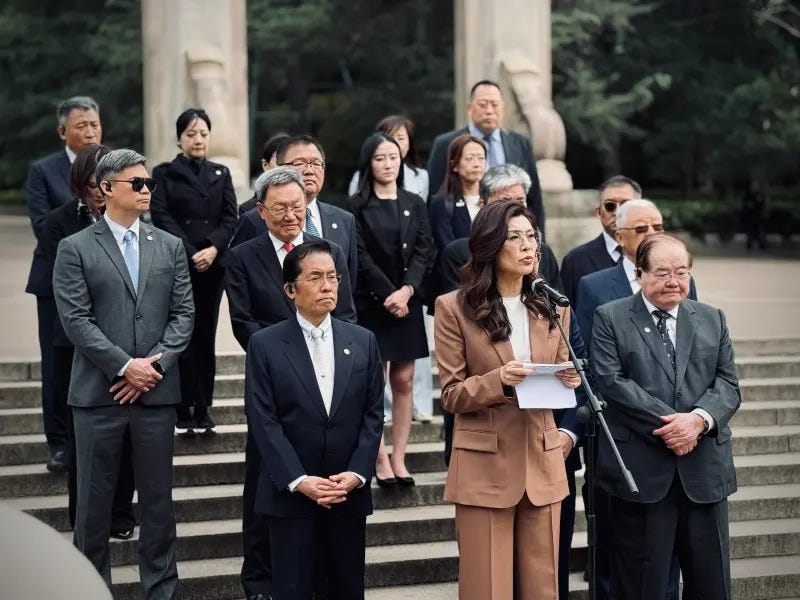
Cheng Li-wun speaks at the Sun Yat-sen Mausoleum in Nanjing, east China’s Jiangsu Province, on April 8, 2026.
On the final day of Cheng’s visit, Beijing announced ten measures aimed at expanding cross-Strait exchanges and co-operation. They included plans to resume individual travel to Taiwan for residents of Shanghai and Fujian, restore or add more direct passenger flights, and widen market access for Taiwanese agricultural and fishery products.
But Cheng and the KMT cannot put these measures fully into effect. The party remains in opposition, and decisions involving entry permits, transport arrangements and official negotiations remain in the hands of the DPP administration.
Even so, unofficial engagement should not be dismissed simply because it cannot resolve the underlying political dispute. A recent report by the National Committee on American Foreign Policy (NCAFP) noted that experts from the United States, the Chinese mainland and Taiwan still saw sustained dialogue as one of the few practical tools available to reduce mistrust and lower the risks of accidental escalation.
Cheng’s mainland trip, together with some of the steps the KMT has taken in Taiwan since then, belongs to this broader effort to put engagement back on the agenda. It has created more room for cross-Strait exchanges and mutual visits to return to public discussion.
Some recent polling also points to clear demand in Taiwan for better relations and renewed communication. A June survey by the Taiwan-based Democracy Foundation found that 59.6% of respondents supported Taiwan taking the initiative to pursue peace talks with the mainland, while 68.7% supported improving cross-Strait relations and working for peace.
Can cross-Strait exchanges become two-way again?
“Communication is an urgent priority.”
That was how the NCAFP summarized one of the main conclusions of a recent high-level Track II dialogue involving experts from the United States, the Chinese mainland and Taiwan.
The report noted that “official cross-Strait dialogue is absent and even unofficial exchanges on issues in cross-Strait relations are rare ... With cross-Strait political trust at a low ebb and formal channels of communication absent, the risk of miscalculation remains uncomfortably high.”
Participants in the dialogue called for expanding cross-Strait exchanges and connections to maintain peace and stability across the Taiwan Strait and make today’s fragile stability durable.
There is good reason for that argument. Exchange does not equal peace. But the past two decades provide at least one period in which political stability and closer interaction reinforced each other.
Between 2008 and 2016, during a period of relatively peaceful cross-Strait relations, two-way travel doubled and reached nearly 10 million trips in 2015. Cross-Strait movement became part of everyday life, creating something of a soft buffer between the two sides.
The experience suggests that political easing and people-to-people contact can work in both directions. Greater political trust made expanded tourism, flights and trade possible. More frequent travel and commerce, in turn, gave more people a direct stake in preserving stability.
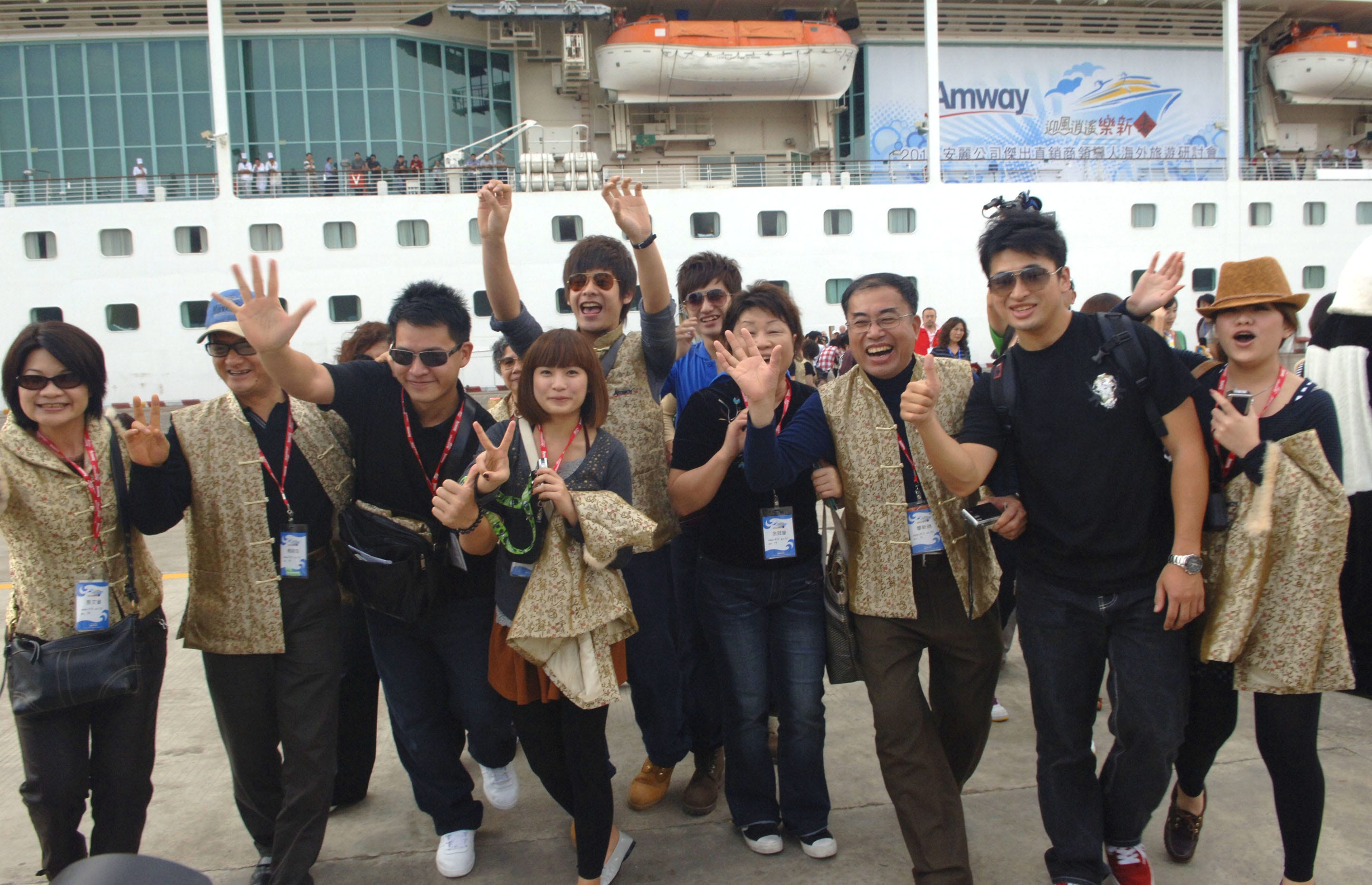
Taiwan tourists pose for photos upon their arrival at Xiuying port in Haikou, capital of China’s Hainan Province, Feb. 8, 2010.
After the DPP returned to power in 2016, political relations deteriorated, and the scale of cross-Strait travel declined. Since pandemic restrictions were lifted, Beijing has repeatedly announced steps to restore travel to Taiwan for residents of selected regions and cities and has proposed adding more flights. The DPP administration, however, has yet to lift key pandemic-era restrictions on mainland visitors, while direct flights remain far below pre-pandemic levels.
As a result, cross-Strait travel has been recovering, but the flow remains markedly uneven.
According to China’s National Immigration Administration, there were 3.12 million cross-Strait trips in the first half of this year, up 22.1% from a year earlier. Taiwan residents accounted for 2.85 million trips to the mainland, an increase of 24.9%.
The figures also show that political tension has not eliminated the demand for contact. People from Taiwan continue to visit the mainland for work, study, family reasons and tourism. Movement in the other direction remains far more restricted.
The DPP administration has yet to produce a plan that can actually restart mainland tourism to Taiwan. It has also said that broader cross-Strait exchanges will be placed under a tighter “risk management” framework.
Earlier this year, the Financial Times published an article titled “Let Chinese mainland tourists return to Taiwan.” It argued that Beijing had already made high-profile political statements about restoring tourism and begun limited reopening measures without securing substantive concessions from Taipei. The article called on Taiwan to show greater flexibility and to compartmentalize tourism from the broader political dispute.
That argument found sympathy within Taiwan’s tourism industry, but it has not received the same response from the DPP administration.
The KMT’s role
The opposition KMT is now trying to serve as a channel of communication across the Strait.
After returning from the mainland, Cheng said the CPC leadership understood that Taiwan had developed a different political system and way of life. She also argued that people in Taiwan should be willing to acknowledge the mainland’s development achievements. Cheng offered to brief Lai personally on what she had heard and observed during the trip.
Her comments predictably drew criticism from political opponents in Taiwan. Some argued that Cheng was too willing to present Beijing’s perspective and paid too little attention to the military pressure around the island. Others worried that party-to-party contacts could allow Beijing to decide which Taiwanese political figures it regards as acceptable interlocutors.
Those concerns are not without basis, but they should not become a reason to reject all engagement.
Cheng’s approach also reflects a simple principle of communication across political divides: dialogue is often most valuable when differences are greatest. Explaining the mainland to people in Taiwan does not amount to endorsing its political system. Engaging and communicating with Beijing does not automatically mean entering talks on unequal terms.
The KMT also has historical experience with this approach.
In 2005, then-KMT chairman Lien Chan led a delegation to the mainland on what became known on both sides of the Strait as an “ice-breaking journey.” It produced the first formal meeting between the top leaders of the KMT and the CPC in six decades. Cheng was the KMT spokeswoman for that trip.
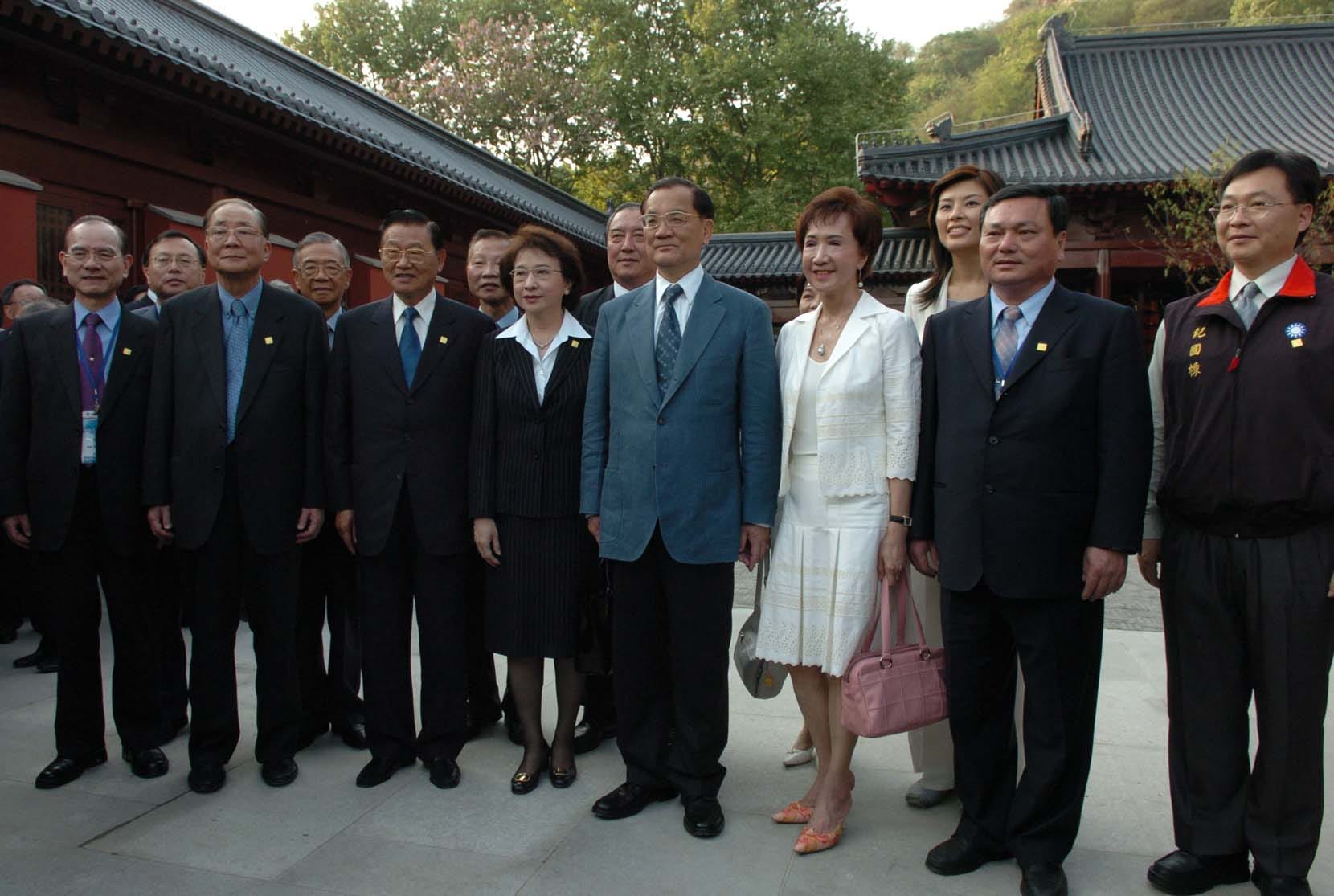
Lien Chan, then-KMT chairman, poses for a photo with other members of the delegation during a visit to the Tianfei Palace in Nanjing, east China’s Jiangsu Province, on April 27, 2005. Cheng Li-wun is third from right.
Three years later, the KMT returned to power, and the heightened cross-Strait tensions that had marked much of the Chen Shui-bian years gave way to a more stable period. Between 2008 and 2016, direct flights, tourism and trade expanded rapidly. In 2015, the leaders of the two sides met face-to-face for the first time since 1949.
Cheng’s decision to travel to the mainland as a sitting KMT chair therefore inevitably invites comparisons with that effort two decades ago.
Engagement matters beyond the Strait
At this year’s meeting between the leaders of the KMT and the CPC, the CPC leadership reiterated that Beijing would respond positively to proposals conducive to the peaceful development of cross-Strait relations. It also described “Taiwan independence” as the principal threat to peace in the Strait.
The DPP does not accept that definition. But Beijing’s view of the issue remains impossible to ignore when trying to understand why official dialogue has been suspended for so long.
What is less disputed is that peace across the Taiwan Strait matters far beyond the two sides themselves.
For the United States, maintaining deterrence in its strategic competition with China and avoiding war are not contradictory goals.
After returning from China in May, U.S. President Donald Trump told Fox News that he did not want to see Taiwan move towards independence. He also questioned the idea of the United States traveling 9,500 miles to fight a war over the island, adding that he did not want such an outcome.
American public support for direct military intervention is also limited. A report published by the Chicago Council on Global Affairs on November 17, 2025 found that, in the event of a war over Taiwan, 51% of Americans opposed sending U.S. troops to defend Taiwan directly.
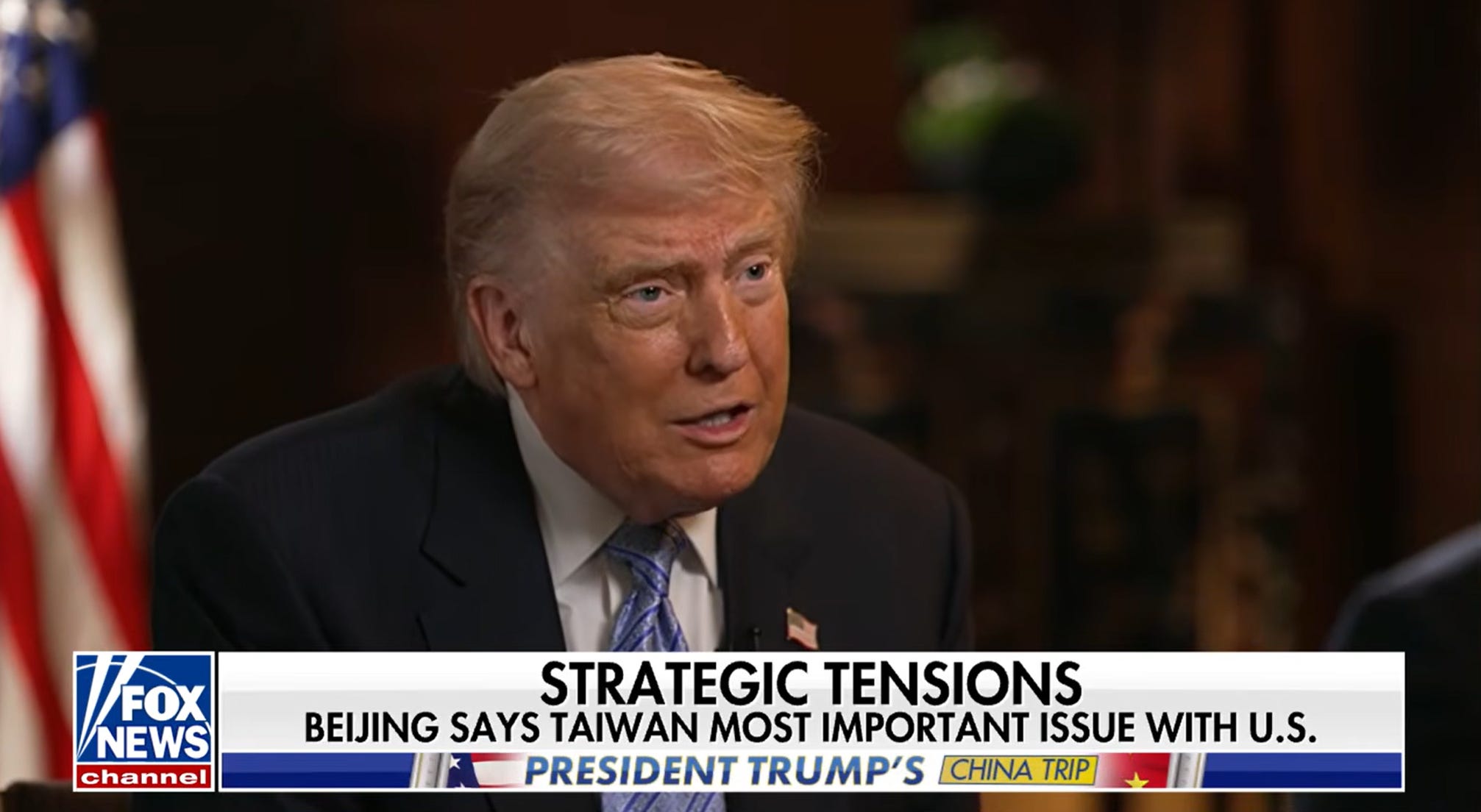
U.S. President Donald Trump speaks during an interview with Fox News, in which he discussed his views on tensions across the Taiwan Strait.
For the rest of the world, the stakes are no less serious.
Taiwan is one of the world’s most important centers for advanced semiconductor production and a key node in East Asia’s manufacturing network. The Taiwan Strait is also one of the busiest maritime corridors. A conflict could hit semiconductor supplies, shipping, trade and financial markets within a very short period.
A Bloomberg Economics study published in February estimated that, in the most severe scenario, a U.S.-China war over Taiwan could cost the global economy 10.6 trillion U.S. dollars, roughly 9.6% of global gross domestic product, in the first year alone. The damage would extend far beyond the main parties. Japan, South Korea, the European Union, India and the United Kingdom could all face severe economic contractions.
A conflict in the Taiwan Strait would therefore be far more than a regional security crisis. It could quickly affect prices, production, investment and employment around the world.
Governments around the world may have limited ability to resolve the underlying political dispute. They do, however, have a clear interest in supporting measures that reduce the risk of escalation.
Economic interdependence and dense people-to-people ties across the Strait can provide additional buffers when tensions rise and preserve more channels for co-operation. Their value becomes greater, not smaller, when the risk of escalation is growing.
The exchanges promoted by Cheng and the KMT cannot resolve all the differences across the Strait. But expecting an opposition party to settle a decades-old cross-Strait issue would set an unreasonable standard.
What the KMT’s efforts help illustrate is that regular flights, functioning ports and ordinary people traveling across the Strait can give both sides a more tangible stake in keeping stability part of everyday life. They can also remind more people that political disagreement does not require all civilian contact to stop.
At a time when conflict has become more common in several parts of the world, creating room for cross-Strait relations to move back towards dialogue and exchange is, at the very least, a starting point worth taking seriously.
