

Good afternoon.
I have long been interested in how local governments in China are run, and longtime readers may have noticed that. I have previously written about what happens when local authorities add layers of requirements as policies move down the administrative chain, the respective roles of a city’s Party secretary and mayor, and debates over whether local governments really need to run social media accounts.
These are not always the topics that attract the most attention, and no single article can cover every aspect of local governance. But I think they offer an interesting way to look at Chinese society.
Today’s post is about local government officials, including mayors, answering calls from residents on government hotlines.
Having senior officials pick up hotline calls is not exactly new, either in China or elsewhere. But I found a recent Southern Weekly article on the subject worth reading for several reasons.
First, the calls themselves offer a glimpse of the concerns people raise in everyday life, and of how those concerns are changing along with Chinese society.
Take western Baotou City, north China’s Inner Mongolia Autonomous Region. Since 2020, the largest category of calls to the city’s government service hotline has concerned human resources and social security, accounting for about 30 percent of the total.
Most of those callers are not filing complaints. They are asking practical questions about social insurance, employee rights, personnel files and similar matters. Social security alone accounts for roughly 85 percent of calls in this category.
“Most people are asking about social insurance contributions and retirement pensions,” said Cao Weizhi, a manager at Baotou’s government service hotline center.
Calls about childcare subsidies, by comparison, are relatively uncommon. That broadly tracks China’s demographic changes: a rapidly aging population and a declining number of births.
In other words, the changing mix of calls reflects changes in society itself. Other problems are hardly unique to Baotou:
Complaints about property management and consumer rights each account for roughly 10 percent of calls to the city’s hotline. Cao said that, as elsewhere in China, complaints about property management companies, including their service and fees, are a highly visible issue.
......
Across China, education and school enrollment, housing and property management, transportation and urban management consistently rank among the most common issues raised when senior officials answer the hotline.
A change in shopping habits has also changed the kinds of disputes citizens bring to the government, and the challenges facing the legal and administrative processes used to resolve them:
Consumer complaints increasingly involve online shopping. “E-commerce disputes are more difficult to investigate, verify and collect evidence for, and they also take longer to resolve,” Cao said.
There is another reason I found the article worth reading. It does not simply celebrate the practice of having the top official personally answer calls. Lai Jingping, an associate professor at Nanjing University’s School of Government, pointed out one of the model’s inherent limitations:
The core of modern governance is to rely on stable, standardized and predictable institutional procedures. If large numbers of everyday problems cannot be solved until the top official personally intervenes, that suggests the routine mechanisms for interdepartmental coordination and handling cases are not working properly.
The article also acknowledges that the effectiveness of this model depends heavily on the personal commitment of the official in charge:
Since the beginning of 2026, senior Party and government officials in Anhui, Guangdong, Hainan, Beijing and other places have personally taken calls on the “12345” government service hotline. The practice of top officials answering public hotlines dates back to the 1980s, but its effectiveness has often been closely tied to the willingness of the official himself or herself to get involved.
My own view is that there are things this kind of direct intervention can do that ordinary procedures sometimes cannot. It can sharply increase the chances that a particular problem gets resolved quickly, and it also sends a visible message about officials paying attention to citizens’ concerns.
But the more important task is to build durable mechanisms that can solve these problems without requiring the personal intervention of the top official.
Mao Shoulong, a professor at Renmin University of China’s School of Public Administration and Policy, makes a similar point in the article:
When administrative and legal institutions are still incomplete, he said, intervention by the top official can fill gaps. But as those institutions mature, officials should make clear that answering hotline calls is a temporary demonstration rather than a normal channel for resolving complaints.
The aim, he said, should be to encourage people to use standardized procedures first and to “eliminate the expectation that every problem should be taken to the top official.”
No governance system is perfect. Having senior officials answer hotline calls can be a useful supplement when certain problems prove difficult to resolve through normal channels. This kind of hybrid approach to governance is not hard to understand in practice.
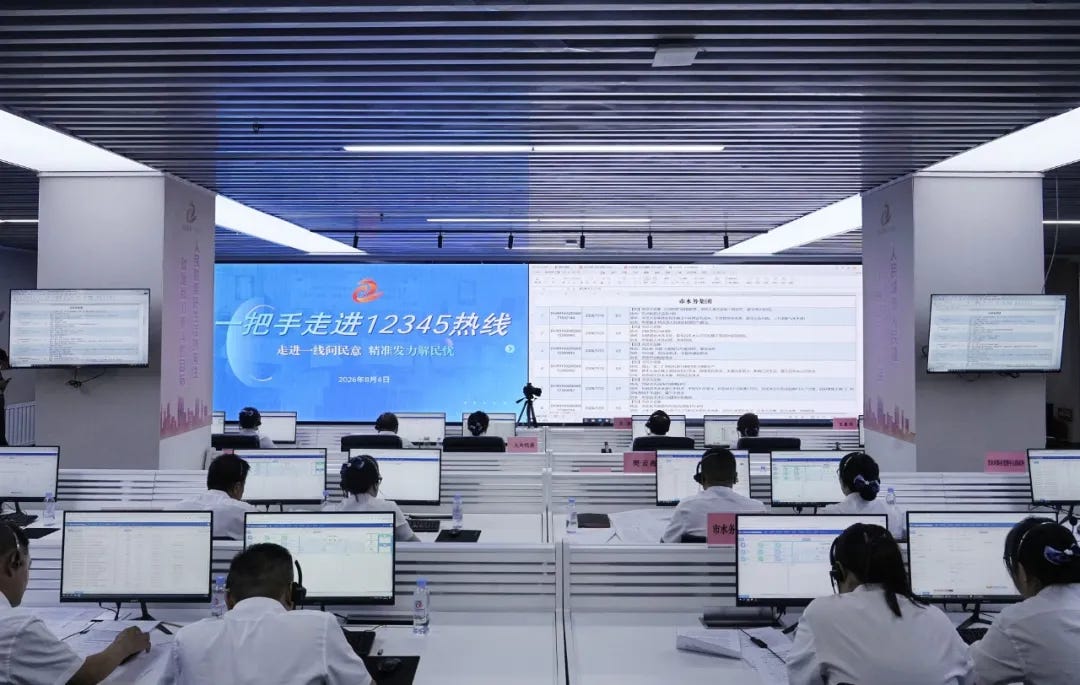
On the morning of August 4, 2026, staff at Baotou’s 12345 government service hotline center briefed Water Resources Bureau officials before they began taking calls.
Below is the full article.
“You don’t need to go looking for anyone else about this. I’ll see it through.”
That promise, made by Baotou Mayor Meng Qingwei on May 22, 2026, quickly spread online and once again drew attention to the Inner Mongolian city known as the “Grassland Steel City.”
Meng made the remark while taking calls at the city’s “12345” government service hotline center.
Baotou began having top officials — the yibashou (一把手), literally the person in charge of a government or department — answer 12345 calls in October 2025. Since then, the head of a government body has taken calls every week.
Baotou launched its government hotline in November 2000. Over the years, the 12345 platform has developed into the city’s main channel for collecting public feedback and handling complaints and suggestions.
The city’s Bureau of Administrative Approval and Government Services had previously tried to coordinate appearances by the heads of districts, counties and municipal departments, but the effort achieved only limited results.
That changed in 2025.
After Chen Zhichang, who had previously worked in Beijing and Jiangsu, became a member of the Standing Committee of the Inner Mongolia Autonomous Regional Committee of the Communist Party of China (CPC) and Party secretary of Baotou, he pushed the program with unprecedented force.
Baotou is not alone. Since the beginning of 2026, senior Party and government officials in Anhui, Guangdong, Hainan, Beijing and other regions have sat down behind the phones at 12345 centers.
The practice of senior officials personally answering hotlines dates back to the 1980s. Its results, however, have often depended on the commitment of the official in charge.
At the same time, Baotou and other cities are trying to move beyond solving individual cases and use what they learn from the calls to improve the way government works more broadly.
“Let leaders see where the problems are”
“Boss, when you start taking calls in a moment, there are three things you cannot say: ‘I don’t know,’ ‘That’s not my responsibility,’ or ‘There’s nothing I can do about it.’”
At 9 a.m. on August 4, 2026, Gao Chong, director of the Baotou Water Resources Bureau, walked into the hotline studio.
Before the session began, staff gave Gao and officials from the relevant divisions a short briefing.
A PowerPoint presentation listed some of the main problems found in the Water Resources Bureau’s handling of requests from residents and businesses between January and August 2026. Among them: revealing callers’ personal information in responses and uploading documents in incorrect formats.
Yun Lei, director of Baotou’s 12345 Government Service Hotline Center, told Southern Weekly that the purpose of this part of the session was to “let leaders themselves see where their department is falling short in handling 12345 cases.”
Yun added another detail.
Under arrangements made by the Baotou municipal Party committee and government, every Tuesday the head of a district or government department answers hotline calls.
This was the Water Resources Bureau’s first session on its own. On Monday afternoon, officials from the bureau had already visited the hotline center to discuss the session and ask for suggestions on how they could improve their work.
Although the activity is called “the top official answering the hotline,” the official does not work alone. A deputy director, division heads and more than a dozen other officials usually take part.
During the 90-minute session that day, officials from the Water Resources Bureau handled 30 calls from residents and businesses, mainly concerning water supply, water-resource management and river-basin administration.
Yun said that, based on past experience, the volume of calls is extremely high when a senior official is taking calls. Hotline operators first screen incoming requests, identify those related to the department taking part that day, and transfer them to the officials.
Gao personally answered five calls.
One came from a resident who suspected that the quality of drinking water supplied directly to his home did not meet safety standards.
Gao told Southern Weekly that he found the claim puzzling.
Water quality is a serious matter, he said. “We test the water according to national standards before it is supplied every day. If it failed the standards, we could not supply it.”
After asking several questions, Gao learned that the caller had bought test strips online that claimed to detect water quality problems.
“The accuracy of those strips cannot be guaranteed,” Gao replied. “How about this: we’ll arrange for a professionally certified testing agency to come to your home and test the water.”
At 10:30 a.m., the phone session ended.
Gao led his team out of the call room and into a consultation room across the hall.
Waiting there were Zhang Yifu, deputy director of Baotou’s Bureau of Administrative Approval, Government Services and Data Management, as well as representatives from what China calls the “two representatives and one committee member”: Party congress delegates, people’s congress deputies and members of the Chinese People’s Political Consultative Conference.
The 12345 hotline center is itself a division of Zhang’s bureau.
This consultation is another part of the program.
Cases received that day are discussed on the spot with these representatives. Each representative takes responsibility for following up on one case. The department that answered the calls also selects several cases for a rapid-response list. Officials are generally expected to visit the site that same afternoon, or by the following day at the latest.
Zhang also raised one unresolved case with the Water Resources Bureau.
A municipal street-cleaning vehicle had sprayed dirty water onto a legally parked car. The owner wanted an apology from the staff involved.
“All the resident is asking for is an apology. There is no reason for this case to have dragged on for so long,” Zhang said. “The city has made it clear that cases are not supposed to pile up. I hope everyone takes this seriously.”
Gao responded:
“This involves management, the details of our work, and even our attitude toward the work. When residents bring us a problem, we need to put ourselves in their position.”
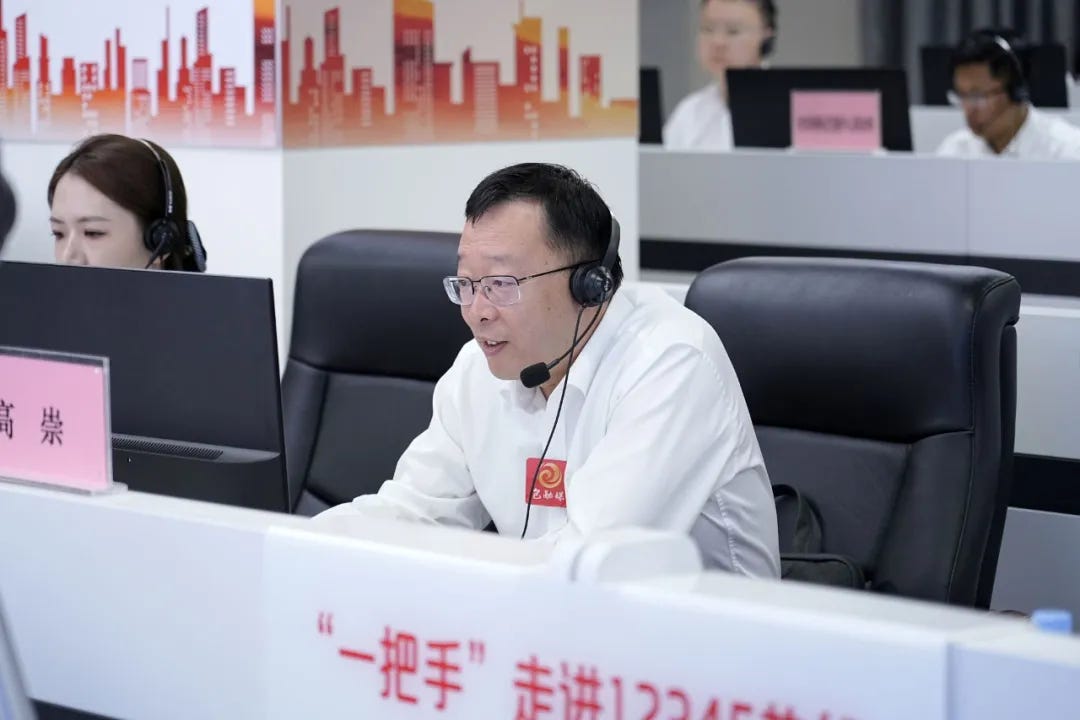
On the morning of August 4, 2026, Gao Chong, director of the Baotou Water Resources Bureau, took calls on the 12345 government service hotline.
Scaling it up
Baotou’s program of having agency heads answer 12345 calls began in October 2025.
Its expansion was closely tied to support from the city’s top leadership.
Yun Lei said that several years earlier, Baotou’s Bureau of Administrative Approval and Government Services — later reorganized into the Bureau of Administrative Approval, Government Services and Data Management — had already tried to invite the heads of banners, counties, districts and municipal departments to take hotline calls.
But the bureau had limited authority to coordinate senior officials, and “the results were fairly average.”
In July 2025, Chen Zhichang, then mayor of Nanjing, was transferred across provincial lines and appointed to the Standing Committee of the Inner Mongolia Autonomous Regional Committee of the CPC and as Party secretary of Baotou.
By early August, the Baotou Party committee and municipal government had already begun making arrangements for senior officials to answer 12345 calls.
Chen had spent more than two decades working in Beijing and had paid considerable attention to the hotline system.
In July 2018, when he was acting district head of Beijing’s Shijingshan District, Chen answered calls on the 12345 hotline and led efforts to repair a badly damaged road south of Beijing Chaoyang Hospital’s western campus after residents complained about it.
In April 2020, when he was mayor of Huai’an in east China’s Jiangsu Province, Chen again took calls on 12345 and told the media how he viewed the hotline:
“It is a bridge, and more than that, it is a promise.”
In May 2025, just over a month before his transfer to Inner Mongolia, Chen, then mayor of Nanjing, appeared on Jiangsu Province’s televised government accountability program Government Conduct Hotline: The Mayor Goes On Air.
With support from the city’s top official, Baotou’s program moved quickly.
It was launched in mid-October 2025. Within a month and a half, the heads and senior officials of seven districts and departments had taken part.
In March 2026, the program resumed in an expanded form.
The city planned 44 sessions for the year, with one every Tuesday, as well as two special sessions for the mayor and vice mayors, one in the first half of the year and another in the second.
Yun explained that the program had been paused at the start of 2026 because of the Lunar New Year and the annual national “two sessions,” when government priorities temporarily shifted.
The timing of each department’s appearance is also planned carefully.
Yun said hotline calls have clear seasonal patterns.
Water use and street vending tend to peak in summer, for example, so the Water Resources Bureau and urban management authorities are scheduled around that time.
The Education Bureau appears around the start of the school year. Housing and construction officials take calls during the winter heating season.
Huang Jie, a member of the Jiangsu Provincial Political Science Association, told Southern Weekly that many of the problems residents raise may look trivial but often involve several government departments and are costly to coordinate.
Many livelihood issues cross departmental, administrative and territorial lines. Some have accumulated over long periods.
Ordinary hotline staff have limited authority to coordinate all of the bodies involved, Huang said, so intervention from a higher level may be needed to break the deadlock.
On May 22, 2026, Mayor Meng Qingwei encountered exactly this kind of problem.
A homeowner at the Yuanzhou Daduhui residential compound in Baotou’s Jiuyuan District called the hotline about installing an electric-vehicle charger in a parking space he owned.
The electricity provider said the installation met the requirements, but the property management company refused to allow it.
Meng told the caller:
“You don’t need to go looking for anyone else. Once it reaches me, this is where it ends.”
With Meng’s direct intervention, the dispute was quickly resolved.
Between the launch of the program in October 2025 and May 2026, 18 senior officials in Baotou had taken hotline calls.
They handled 2,011 requests and helped resolve 1,959 of them.
The city’s backlog of unresolved cases fell from more than 20,000 in 2025 to just over 3,000.
What people are calling about
What are residents actually calling the government about?
Cao Weizhi, a manager at Baotou’s 12345 hotline center, told Southern Weekly that since 2020 the single largest category has been human resources and social security, accounting for roughly 30 percent of all calls.
Most of those calls are not complaints.
People are asking practical questions about social insurance, workers’ rights, personnel files and other administrative matters.
Social security alone accounts for around 85 percent of calls in this category.
“Most people are asking about social insurance contributions and retirement pensions,” Cao said.
Calls about childcare subsidies are much less common, a pattern consistent with broader demographic changes as the population ages and the number of newborns continues to decline.
Complaints about property management account for around 10 percent of total calls, as do complaints involving consumer rights.
Cao said problems involving the service and fees charged by property management companies are a highly visible issue in Baotou, as they are elsewhere in China.
Consumer complaints, meanwhile, increasingly involve online shopping.
Changing consumer habits have made consumer protection more difficult.
“E-commerce disputes are harder to investigate and verify, harder to collect evidence for, and they tend to take longer,” Cao said.
Since April 2026, senior Party and government officials in places ranging from Inner Mongolia and Anhui to Guangdong and Hainan have taken seats at 12345 call centers.
Across China, education and school enrollment, housing and property management, transportation and urban management consistently rank among the most common issues raised when senior officials answer the hotline.
In Beijing’s Chaoyang District, statistics for the first five months of 2026 showed that the most common hotline keywords were concentrated in four areas: market regulation, private training and education services, housing, and labor and social security.
On April 22, 2026, Chen Jianrong, head of Guangzhou’s Tianhe District, answered 16 calls from residents.
They covered market regulation, urban and rural construction, education, science, culture and sports, including consumer disputes, unauthorized construction and property management.
The situation was similar in Hainan.
On May 9, 2026, Wuzhishan Mayor Chen Guoliang answered five calls involving urban management, social welfare and planning inquiries.
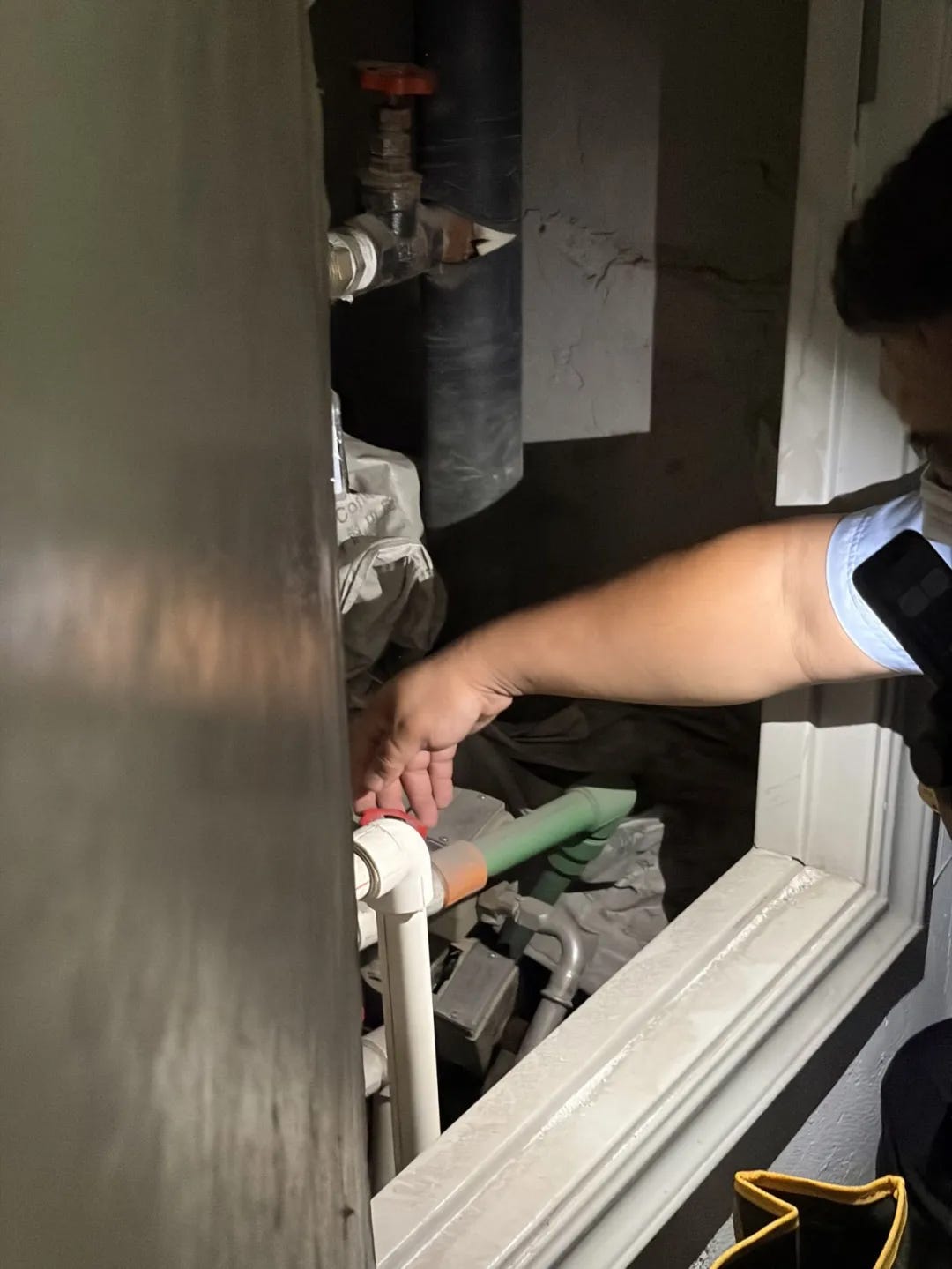
A resident on the 13th floor of a residential compound in Baotou reported low water pressure during peak hours. On the morning of August 5, 2026, staff from the Baotou Water Resources Bureau visited the home to inspect the problem.
Reducing the expectation that everything requires the top official
Senior officials directly listening to complaints is not a new form of governance.
The logic is similar to regular petition-reception days, televised government accountability programs and online platforms where officials respond to public concerns.
Lai Jingping, an associate professor at Nanjing University’s School of Government, told Southern Weekly that 12345 hotlines began spreading around the late 1990s and early 2000s.
By around 2010, some localities had already experimented with having senior officials take calls, although it did not become a nationwide or routine practice. Only in recent years has the model spread more widely.
According to the Shenyang municipal government website, in September 1983 the city government established a public telephone line for the mayor.
It was the first mayoral hotline in China and became the starting point for more than four decades of government hotline development.
Other cities soon followed.
On June 15, 1999, Hangzhou established a public-call center for the mayor and assigned it the number 12345.
That number gradually spread nationwide and became the standard number for government public-service hotlines.
When Jinan launched its 12345 citizen hotline in September 2008, then-mayor Zhang Jianguo went to the call center himself and answered residents’ calls.
Jinan later established a regular system under which senior officials took calls on designated days, making it one of the earlier Chinese cities to institutionalize the practice.
According to China Central Television, Zhengzhou in Henan Province began arranging for the mayor or a vice mayor to take calls once a month from January 2005, making it one of the earliest publicly documented efforts to formalize hotline duty for senior local officials.
Over the next two decades, Xiamen, Beijing, Zhejiang and other localities tried similar approaches.
There is no national requirement forcing local leaders to do so.
Beijing’s approach is one of the more developed examples.
Its “Listening to Public Opinion, Addressing Public Concerns” initiative has now been running for eight years. The program has developed a rotating format involving the Party secretaries of Beijing’s 16 districts, supported by on-site consultation and follow-up supervision.
In practice, local 12345 hotlines have resolved many residents’ problems.
When the top local official personally answers calls, the impact can be immediate.
But Lai argues that this model also has an inherent limitation.
The core of modern governance, she said, is to rely on stable, standardized and predictable institutional procedures.
If large numbers of everyday problems can only be resolved after the top official steps in, that indicates that routine mechanisms for interdepartmental coordination and case handling have broken down.
Mao Shoulong, a professor at Renmin University of China’s School of Public Administration and Policy, holds a similar view.
When administrative and legal institutions are incomplete, he said, intervention by the top official can compensate for their shortcomings.
Once those systems are mature, however, it should be made clear that senior officials answering hotline calls is a temporary demonstration rather than the normal way for citizens to seek help.
People should be guided toward standardized administrative channels first, Mao said, so as to “eliminate the expectation that every problem should be taken to the top official.”
That is why one of the main questions facing local governments is how to turn individual cases raised during hotline sessions into changes in the system itself.
Baotou is also trying to do this.
Zhang Yanbin, a fourth-level researcher at the Baotou Urban Management Bureau, has firsthand experience of why broader institutional solutions are needed.
On July 27, 2026, when the head of the bureau took part in a 12345 hotline session, Zhang also answered six calls.
The one he remembers most clearly involved a factory built on collectively owned village land in one of the city’s districts.
Years earlier, the local township government had allowed the factory to be built as part of an investment-promotion effort.
Under current law, however, the structure is considered illegal.
Resolving a case like this takes time.
“If you want to make sure the entire enforcement process complies with the law, you first need to seek the planning department’s opinion, then issue formal notices, and eventually apply to a court for compulsory demolition,” Zhang said.
“You are looking at at least six months.”
Li Yang, director of the Baotou Urban Management Bureau’s monitoring and command center, told Southern Weekly that the case is now being handled jointly with the local district government, with senior officials directly following its progress.
The Urban Management Bureau has already developed a set of procedures for complicated 12345 cases.
Different plans are used for disputes involving multiple departments or administrative levels, cases where responsibilities are unclear, cases that have failed to be resolved after repeated negotiations, recurring problems shared by many residents, and cases that could create public controversy if officials respond only after a complaint has escalated.
There have also been changes at the city level.
Materials provided to Southern Weekly by the Baotou municipal government office show that since senior officials began taking part in the 12345 program, the city has established several new working mechanisms.
One of the more notable is a system for interdepartmental coordination.
Under this arrangement, the municipal government brings together the main departments responsible for areas that frequently generate livelihood complaints.
They prepare contingency plans in advance and add temporary specialist desks to the hotline center when necessary, with the aim of responding more quickly and precisely to high-frequency problems.
After the senior-official hotline program began in October 2025, Baotou’s housing and construction authorities also began renovation work in several areas that had generated large numbers of complaints.
Some places that had not originally been included in renovation plans were brought forward because officials identified them as likely sources of recurring problems.
The basic idea is simple: solve common problems before they require the personal attention of the city’s top officials.