

China recently filed network information plans with the International Telecommunication Union (ITU) to deploy 203,000 satellites across 14 constellations, marking the country’s largest-ever coordinated international filing for satellite frequency and orbital resources, according to Science and Technology Daily (科技日报), a newspaper under the Ministry of Science and Technology.
As this move is unprecedented in scale, it has quickly attracted attention at home and abroad. Science and Technology Daily reported that a Chinese expert who has been deeply involved in ITU-related affairs said the filings should be viewed in a rational manner:
中国幅员辽阔,是卫星技术应用大国,结合卫星技术应用实际和未来发展需求,在国际规则框架下,此次申报了多份卫星网络资料,其中有两份超过9万颗卫星。
China is vast in territory and a major country in the application of satellite technologies. In light of the realities of satellite applications and future development needs, and within the framework of international rules, China has, this time, filed multiple sets of satellite network projects, two of which involve more than 90,000 satellites.
截至目前,已有多个国家根据自身情况申报了卫星规模10万颗以上的卫星网络资料。受卫星频率轨道资源国际协调、系统建设、市场需求变化等多种因素影响,多数情况下,相关公司后续实际部署的卫星规模、技术参数等还会进行动态优化调整。
As of now, multiple countries have, based on their own circumstances, filed satellite network projects involving more than 100,000 satellites. Influenced by a range of factors such as international coordination of satellite frequency and orbital resources, system construction, and changes in market demand, in most cases the actual number of satellites ultimately deployed, as well as technical parameters and other aspects, will be dynamically optimized and adjusted in subsequent steps by the relevant companies.
该专家表示,卫星系统从卫星网络资料国际申报、国际协调到卫星发射、系统建设、提供服务、应用推广,一般需要较长时间。此次我国相关单位申报的卫星网络资料,属于履行ITU相关程序的例行操作,应予以理性看待。
The expert said that the entire process—from international filing of satellite network information and international coordination, to satellite launches, system construction, service provision, and application rollout—generally takes a relatively long time. The satellite network information filed by relevant Chinese entities this time constitutes routine work in fulfilling ITU-related procedures and should be viewed rationally.
Yang Feng, founder and CEO of commercial satellite company Spacety, based in Changsha, Hunan province, said the 203,000 satellite filings reflect long-term national strategy and space resource planning rather than immediate engineering capability, China Daily reported.
A short explainer video released by the WeChat account of China Central Television’s flagship evening news program Xinwen Lianbo also noted that the filings amount to “a ticket for strategic reserve” (”战略储备的一张门票”), adding that China has the world’s largest demand for 5G and 6G communications, intelligent connected vehicles, and the Internet of Things. China’s vast market, the video said, is large enough to absorb massive volumes of satellite data services, providing a sustained flow of capital and momentum for the entire industry.
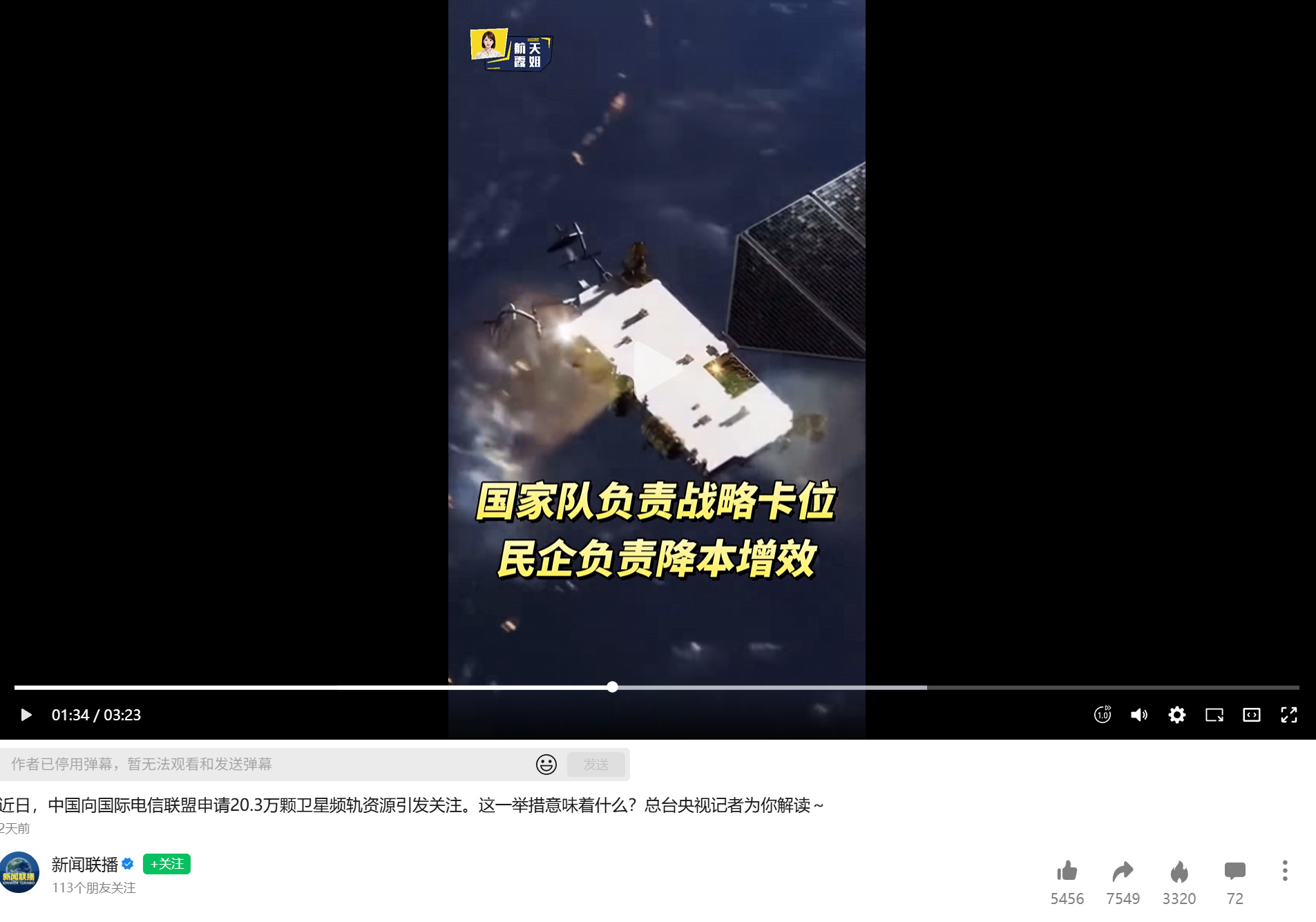
The video likewise called for a rational view of the applications, pointing out that under ITU rules governing frequencies used for broadband satellite internet, applicants must launch 10 percent of the satellites within seven years, complete 50 percent within nine years, and finish full deployment within 14 years. The number of satellites launched can also be adjusted in light of future conditions, including reductions in the overall scale.
The video further analyzed the long-term significance of the filings, highlighting several potential impacts:
1. No more loss of mobile connectivity. In the future, in areas such as oceans, deep mountains, deserts, and other terrestrial signal blind spots, ordinary mobile phones could connect directly to satellites, enabling voice calls and internet access without restrictions.
2. Smarter intelligent vehicles. Direct satellite connectivity could provide autonomous driving systems with round-the-clock, high-precision positioning and communications support.
3. More reliable emergency communications. When natural disasters cause ground-based networks to collapse, satellite networks could serve as the last lifeline.
In addition, the video noted that some Chinese companies have already achieved batch, assembly-line production of satellites, and that China’s capabilities in reusable rockets are expected to continue improving. As satellite mass production advances and launch costs decline, service prices are also expected to become more affordable.
It is worth noting that of the 203,000 satellites covered by the filings, roughly 193,000 of the satellites were proposed by the Institute of Radio Spectrum Utilization and Technological Innovation (无线电创新院), a newly registered national research institute on radio spectrum innovation and commercialization based in Hebei, according to an article published on the WeChat blog of China.com (中华网), a Chinese-language news and information website under China International Broadcasting Network (CIBN).
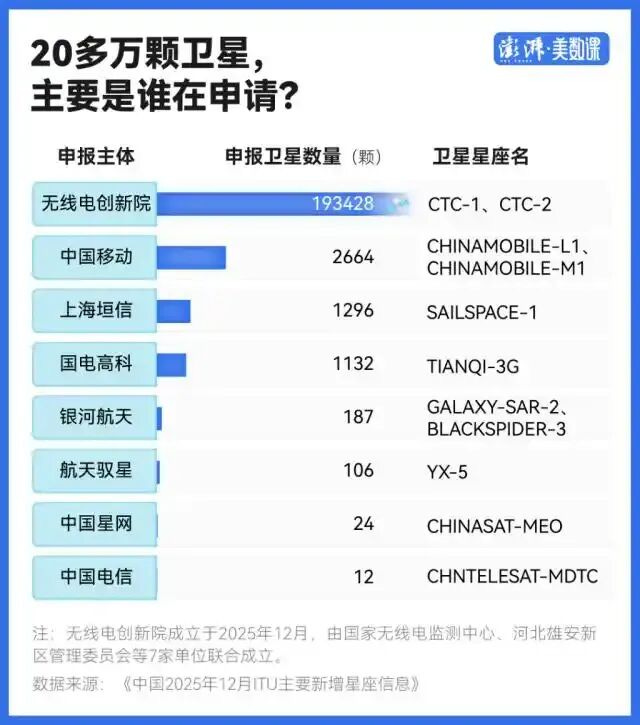
China.com reported that the institute was jointly established by seven entities, including the State Radio Monitoring Center (国家无线电监测中心) and China Satellite Network Group (中国卫星网络集团), underscoring strong organizational coordination and national-level planning. At the same time, China Satellite Network Group and China Mobile also filed their own constellation plans, forming a structure characterized by “state-led coordination with participation from multiple actors” (“国家队主导、多主体协同”)
China.com also analyzed the scarcity of low Earth orbit (LEO) resources. Although space may appear vast, the low-altitude orbital regions suitable for deploying communications satellites are in fact limited. Industry estimates suggest that even under the most relaxed assumptions on safe spacing, LEO can accommodate fewer than 180,000 satellites in total.
At present, U.S. company SpaceX has already deployed around 10,000 satellites for its Starlink constellation and plans to expand the network to as many as 42,000. Other countries, including Rwanda, have also submitted applications — often through third-party intermediaries — for hundreds of thousands of satellites, seeking to gain an early advantage.
From a broader perspective, China.com said that competition over orbital and frequency resources also reflects a struggle for influence in global space governance. For a long time, rules governing orbital slots and spectrum allocation have been dominated by Western countries. China’s active participation in this competition through compliant and rule-based channels represents not only adherence to international norms, but also a necessary step in securing fair development space for itself.
If you’re interested in the links between China’s latest filings and capital markets, you may want to read a related newsletter by Amber Zhang published on Baiguan, which explores this angle in greater detail.

This filing represents two distinct strategic phases.
Phase 1: The Defensive "Squat" (Filling). LEO spectrum is finite real estate. Under ITU's "First Come, First Served" rules, System B is filing 203,000 slots not necessarily to launch them all tomorrow, but to prevent System A (Starlink) from establishing a Monopoly on the Sky. It is a sovereign denial of service against total enclosure.
Phase 2: Vertical R.I.C.E. Once the orbital slots are secured, System B intends to elevate its terrestrial R.I.C.E. framework to 500km altitude.
[R.I.C.E. framework] https://chinarbitrageur.substack.com/p/the-underlying-operating-system-of?r=71ctq6
The Industrial Reality: Look at the "Assembly Line" mention in the report. System B is betting that Satellite Manufacturing will follow the EV trajectory. Ten years ago, EVs were boutique luxury goods. Today, System B prints them like toasters. The present of the Chinese EV industry is the future of the Chinese Satellite industry: Massive scale, brutal cost compression, and total supply chain dominance.