

China’s Hainan Free Trade Port (FTP) officially launched island-wide special customs operations on Thursday. Chinese policymakers described the move as a landmark move of China to unwaveringly expand high-standard opening up and promote the development of an open world economy.
Like many others, I have been waiting for this day for a long time.
I have personally visited Hainan Island three times. Two of those trips were to attend friends’ seaside weddings — which, in a way, already says something about Hainan’s character. Through my regular interactions with people working and living there, I have also learned that the central government has dispatched a large number of officials from other provinces to support Hainan’s development. Over the years, I have consistently felt how strong Beijing’s determination is to make Hainan work.
For this newsletter, I reviewed official explanations of the launch of island-wide special customs operations and spoke with several Chinese experts, organizing their perspectives into this briefing.
I want to give special credit to my colleague Wu Maohui, a Xinhua reporter based long-term on Hainan Island. He has deep expertise on the Hainan FTP and provided me with a great deal of valuable background and insight.
Before diving in, two clarifications:
1. The views expressed by the experts quoted here represent their personal opinions. I have organized them by theme mainly to offer overseas readers a structured reference for understanding the Hainan FTP.
2. Information related to the Hainan FTP is vast. This piece does not aim to be exhaustive. Instead, it highlights issues that overseas readers may care most about. If you would like to explore further, or have feedback, feel free to write to me.
Where Is Hainan?
Hainan Province lies at the southernmost tip of China. It is separated from Guangdong Province to the north by the Qiongzhou Strait, faces Vietnam across the Beibu Gulf to the west, and borders the Philippines, Brunei, Indonesia, and Malaysia across the South China Sea to the east and south.
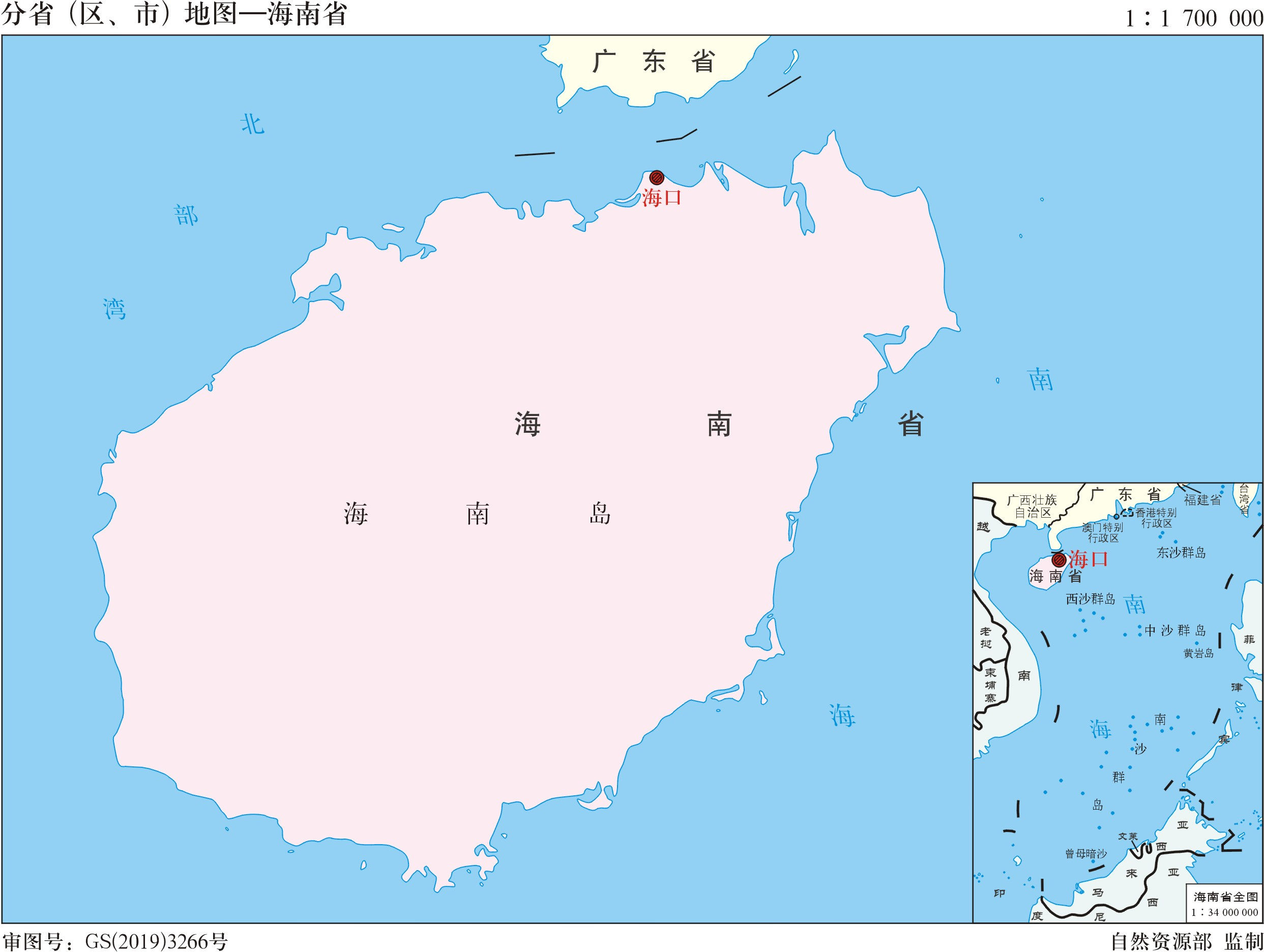
By the end of 2024, Hainan’s permanent population reached 10.48 million, an increase of 51,000 from the previous year, according to the official website of the Hainan FTP.
What’s Special About Hainan FTP?
Two-tiered special customs system. Under the island-wide customs operations, the Hainan FTP will implement a supervision model featuring “freer access at the first line, regulated access at the second line, and free flows within the island.”
The “first line” refers to Hainan’s connection with overseas markets. Meanwhile, the “second line” denotes the customs boundary between the island and China’s mainland.
In practice, “freer access at the first line” refers to freer trade between Hainan and areas outside China’s customs border, and “regulated access at the second line” means maintaining standard customs controls for China’s mainland.
What Does This Mean for Business?
Zero tariffs. With the launch of island-wide customs operations, the scope of zero-tariff treatment in Hainan will expand significantly. The number of tariff lines eligible for zero tariffs will increase from about 1,900 to around 6,600, raising the overall zero-tariff ratio from 21% to 74%.
Strong tax incentives. Companies can benefit from multiple policies across different stages of production and operation. Take a biopharmaceutical company as an example: during the construction and research phase, imported raw materials and equipment can qualify for zero tariffs, reducing import costs by 5 to 10 percent. In manufacturing, products made with zero-tariff imported inputs and meeting a value-added ratio of 30 percent or more can be shipped to the Chinese mainland free of import duties.
Once profitable, the company can also benefit from a preferential corporate income tax rate of 15 percent, while its executives and technical staff may qualify for a 15 percent personal income tax rate.
For foreign enterprises, this arrangement offers a stable interface through which they can simultaneously engage global markets and China’s vast domestic demand. For domestic firms, it provides a gateway to global resources, technologies and capital flows.
Why It Matters
Following the launch of island-wide customs operations, zero-tariff treatment now covers the entire industrial chain — from raw materials and components to final products. This is expected to help extend, reinforce, and optimize industrial chains, and support the cultivation of globally competitive industrial clusters in Hainan.
The 30% value-added threshold not only lowers operating costs for firms, but is also expected to attract more high-end manufacturing and high value-added processing industries to Hainan.
Key Industries
According to the Master Plan for the Construction of Hainan Free Trade Port and the Recommendations of the CPC Hainan Provincial Committee on Formulating the 15th Five-Year Plan for National Economic and Social Development, the post–customs-operations phase will focus on building a Hainan-specific modern industrial system.
The Hainan FTP will prioritize four leading sectors:
Tourism
Modern services
High-tech industries
Efficient tropical agriculture
At the same time, it aims to further develop consumer markets such as high-end shopping, healthcare, and international education.
Timeline: How We Got Here
(Analyzed by 赵晋平 Zhao Jinping, Vice Chairman of the China Association of Trade in Services, based on official documents)
Stage 1 (2018–2020): “Laying the foundation.”
In April 2018, The Chinese leadership announced the decision to build the entire island of Hainan into a pilot free trade zone. At the time, however, China already had more than a dozen FTZs nationwide. Hainan’s pilot FTZ did not yet differ fundamentally from others, nor did it fully reflect the ambition of “higher-standard opening-up.” This stage was primarily about accumulating experience.
Stage 2 (2020–2025): “Building institutions.”
In June 2020, China released the Master Plan for the Construction of Hainan Free Trade Port, emphasizing that by the time of customs operations, a basic institutional framework for the FTP should be “initially formed.” This phase focused on institutional construction on top of earlier groundwork.
Stage 3 (2025–2035): “Full coverage.”
Starting Dec. 18, 2025, island-wide special customs operations are implemented. “Full coverage” means replicating and institutionalizing the systems initially formed before customs operations across the entire province, turning them into long-term arrangements.
Stage 4 (After 2035): “Strengthening distinctive features.”
Financial Preparation
To facilitate high-level convenience for cross-border capital flows, China’s central bank and the State Administration of Foreign Exchange launched multi-functional free trade accounts in May 2024 to create an integrated local and foreign currency account system.
The People’s Bank of China (PBOC) said it has built a financial policy and institutional system specifically designed to support the high-standard construction of the FTP, providing strong momentum for the port’s development.
Other Points You May Find Interesting
How big is the Hainan FTP?
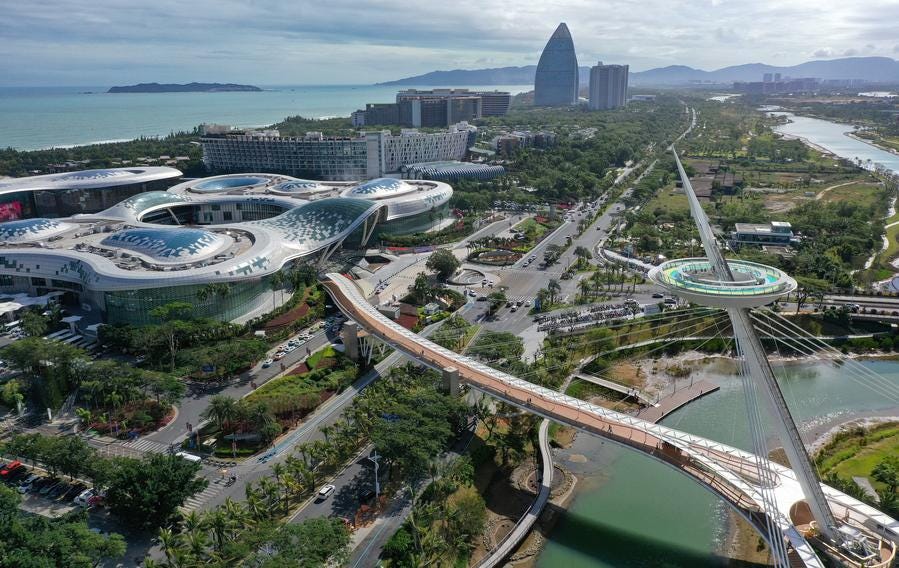
At 33,900 square kilometers, it is 31 times the size of Hong Kong and 47 times that of Singapore, making it the world’s largest free trade port by area, according to National Business Daily, a nationwide Chinese financial and economic daily newspaper.
Going Deeper: Geography and Strategy
In 2018, China unveiled the guidelines to support Hainan to deepen reform and opening up, making clear that the Hainan FTP is intended to serve as a key gateway for China’s opening-up toward the Pacific and Indian oceans
This positioning as a “key gateway of opening-up” is critical. Why does it matter so much?
迟福林 Chi Fulin, head of the China Institute for Reform and Development:
In my view, this point is particularly important. To begin with, the nature of globalization itself is changing. Regional economic integration has increasingly become the dominant feature of globalization, and this trend is now irreversible. Under these circumstances, the development of the Hainan FTP cannot be approached by “looking at Hainan from within Hainan.” Instead, it requires “looking at Hainan from beyond Hainan” — leveraging national strategy to drive Hainan’s development, and in turn using Hainan’s development to reinforce China’s broader strategic objectives.
Hainan’s orientation toward the South China Sea gives it a distinctive resource and geographic advantage. An estimated 60 to 70 percent of China’s imports and exports pass through the South China Sea, either entering the country or heading toward the Indian and Pacific Oceans. This geographic position is therefore of exceptional importance. Against the backdrop of deepening regional economic integration, Hainan’s regional role becomes particularly prominent.
Hainan’s locational advantages — especially its geographic, geopolitical, and resource advantages — are highly pronounced. Historically, Hainan has maintained close ties with regions centered on ASEAN. In building itself into an “important gateway of opening-up,” the most critical counterpart for Hainan is ASEAN. Hainan must become a hub for strategic cooperation between China and ASEAN. Without this hub role, the notion of an “important gateway of opening-up” would remain abstract and fail to materialize in practice. This positioning is therefore crucial — and at present, this trajectory is becoming increasingly evident.
What Does This Mean for Overseas Capital?
Hainan to issue 10-year offshore RMB aerospace bonds in HK -- China Daily (Sept. 12, 2025)
The government of Hainan province has announced plans to issue offshore renminbi bonds worth 5 billion yuan ($702 million) in the Hong Kong Special Administrative Region (HKSAR) this September, aiming to deepen cooperation between the island province and the HKSAR, advance the development of the Hainan Free Trade Port, and contribute to the internationalization of the yuan.
This year marks the fourth consecutive year that Hainan has issued offshore RMB bonds in Hong Kong. A global investor conference was held on Thursday at the Hong Kong Monetary Authority (HKMA) to provide more details about the issuance.
In addition to three-year green bonds and five-year blue bonds, this year will feature the inaugural issuance of a 10-year aerospace bond, with a portion of the proceeds allocated to infrastructure development at Hainan’s Wenchang Spacecraft Launch Site.
Hainan has now issued offshore RMB local government bonds in Hong Kong for four consecutive years. This carries two layers of significance, according to 曹远征 Cao Yuanzheng, former Chief Economist of the Bank of China and advisor to the Hainan FTP:
First, it serves as a signal of leading openness. It is relatively uncommon for local governments to issue renminbi-denominated bonds in Hong Kong, and even less common for the proceeds to be repatriated for use on the mainland. This, in practice, reflects the financial facilitation of the Hainan FTP.
Second, the issuance also carries strong symbolic meaning. Take the so-called “航天主题债” (”aerospace-themed bond”) as an example: Wenchang International Aerospace City in Hainan and related aerospace industries are experiencing rapid growth, and China is emerging as an important global leader in this field. These developments provide important support for Hainan’s successful bond issuance.
Looking ahead, as the Hainan FTP moves into the phase of special customs operations, Hainan will find it easier — and have greater confidence — to access international markets. As facilitation improves, more international capital is likely to flow into Hainan, helping to turn the province into a high ground for reform and opening-up.
Challenges Ahead (A Reality Check)
No ready-made model. Customs operations mark a new beginning rather than an endpoint for Hainan. There is no existing template to copy for Hainan FTP. China has explicitly called for building a “free trade port with Chinese characteristics,” meaning the model must be created through experimentation and continuous adjustment.
— 王新奎 Wang Xinkui, Chairman of the Shanghai WTO Affairs Consultation Center
Implementation discretion matters. The effectiveness of top-level design depends not only on how detailed it is, but also on the degree of flexibility local governments have in implementation. This requires both initiative at the local level and sufficient tolerance for trial and error from the center. Without such space, innovation becomes risky and policy implementation tends to fall into inertia.
— 刘尚希 Liu Shangxi, former President of the China Academy of Fiscal Sciences
Service trade remains a bottleneck. Although Hainan has a negative list for service trade, it still contains around 70 restrictive measures. Compared with CPTPP or even RCEP standards, gaps remain. During the 15th Five-Year Plan period, breakthroughs in this area will be crucial.
— 赵晋平 Zhao Jinping, Vice Chairman of the China Association of Trade in Services
More information:
1. Special customs operations promise broad gains for businesses, residents in Hainan FTP (Xinhua)
2. How individuals calculate income tax incentives in Hainan (National Business Daily)
3. Former Chongqing mayor Huang Qifan on the latest developments in Hainan FTP (New Economist)