

This year marks the 105th anniversary of the founding of the Communist Party of China (CPC), and also the first year of China’s 15th Five-Year Plan period (2026-2030). In February, the CPC launched a Party-wide study and education campaign on establishing and practicing a correct view on governance performance.
In a political commentary published by Xinhua News Agency on Jun. 29 to mark the Party’s 105th anniversary, the article noted that during the Party-wide campaign on establishing and practicing a correct view on governance performance, some cases involving deviations, distortions, and misplaced priorities in officials’ understanding of governance performance had been publicly reported and seriously dealt with. This, the commentary said, sent a strong signal that new achievements in Party self-governance would help safeguard the broad journey of Chinese modernization.
If you have been following China closely in recent years, you would be aware that after the 20th National Congress of the CPC, the Party launched a series of education campaigns: one in 2023 focused on studying and implementing Xi Jinping Thought on Socialism with Chinese Characteristics for a New Era; one in 2024 on studying CPC discipline; and one in 2025 on strengthening compliance with a code of conduct known as the “Eight-Point Rules,” which many of you have read about in this newsletter. The campaign on the view of governance performance is this year’s equivalent theme.
Therefore, I believe this campaign is worth paying attention to.
As with many similar CPC campaigns, the Party has presented both model cases and cautionary cases. This is a very common method in such campaigns: using concrete cases to tell the whole Party what should be advocated, and what kinds of mistakes should be avoided as much as possible.
Just last month, the website of the CPC Central Commission for Discipline Inspection (CCDI) published five “typical cases of deviations in the view of governance performance.” One of them involved a local official who, in a one-sided pursuit of short-term economic benefits, placed economic indicators above ecological red lines and blindly introduced multiple highly polluting chemical companies into a county industrial park.
Meanwhile, in the 12th issue of China Discipline Inspection and Supervision (《中国纪检监察》杂志), a magazine overseen by the CCDI, published in June this year, a column on the view of governance performance included a model case related to ecological protection. The article was titled “Planting Trees for the People for 76 Years — The Plain View of governance performance in the ‘Youyu Spirit.’”
Because the concept of governance performance covers many fields, I will not summarize all of them in a single piece. So in today’s observation of the CPC’s campaign on the view of governance performance, I have decided to focus on ecological protection. I think readers from different countries can probably understand this topic more easily.
First of all, if you look at the CPC from a longer historical perspective, you will find that the Party has always attached considerable importance to ecology.
An article published in 2021 on the website of the Institute of Party History and Literature of the CPC Central Committee noted that during the revolutionary war years, the CPC carried out tree-planting and afforestation activities in revolutionary base areas. It also said that after the founding of the People’s Republic of China, the first generation of the Party’s central leadership began to promote ecological civilization construction nationwide. The article further discussed the theoretical and practical achievements of China’s continued ecological civilization efforts after reform and opening-up, as well as in the current era.
In March this year, Guangming Daily, a newspaper run by the CPC Central Committee and mainly read by intellectuals, published an article titled “Understanding the Ecological and Environmental Dimension of the CPC’s Revolutionary History.” The author was Li Jinzheng, a professor at the Center for Chinese Social History and the School of History at Nankai University. The article offered a deeper discussion of the relationship between the CPC’s revolutionary history and the natural environment.
In its conclusion, the article said that the CPC “turned favorable natural conditions into advantages, and turned unfavorable natural conditions into favorable ones,” arguing that this reflected the Party’s strong initiative and creativity.
Against this broader backdrop, the article in China Discipline Inspection and Supervision about 76 years of tree planting in one county becomes particularly interesting.
The place in question is Youyu County in north China’s Shanxi Province.
I usually live in Beijing. One of the most visible changes I have felt over the years is that many international visitors who have been to Beijing now say that the weather is clearer than they had imagined. In the past, sandstorms often hit Beijing, and there were days when you could not see the blue sky.
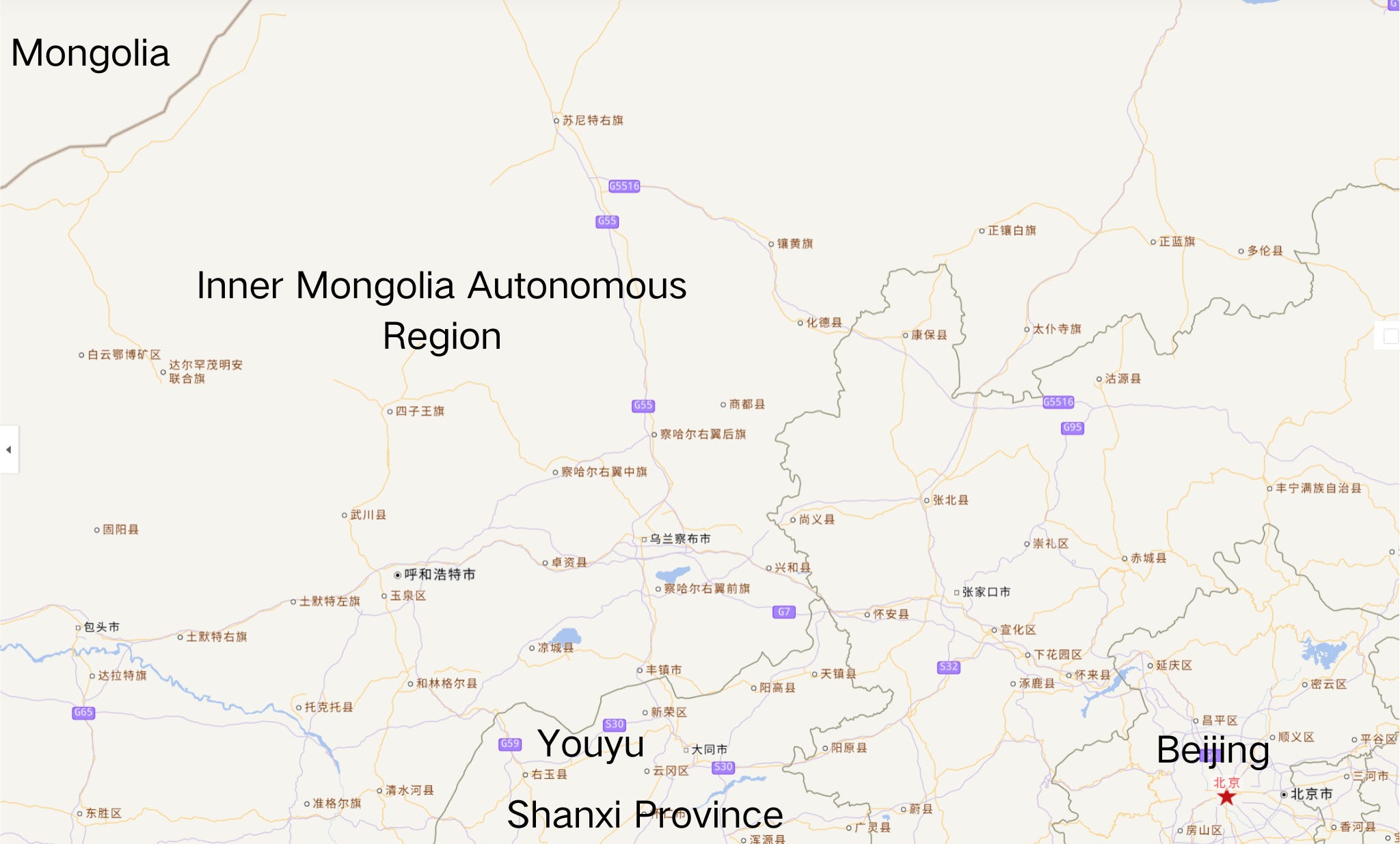
Looking at the map, Youyu is basically at the same latitude as Beijing. It sits at the junction of Shanxi Province and the Inner Mongolia Autonomous Region. Given this geographic location, strong winds and sandstorms were hardly surprising.
According to the magazine article, in June 1949, Zhang Ronghuai, the first Party secretary of Youyu County, arrived to take up his post. On the very day he arrived, he happened to encounter a strong wind:
“It was not an ordinary wind. It was the kind of wind that turned the sky yellowish brown. In broad daylight, you could not clearly see the face of someone standing opposite you. The sand hit people’s faces so hard that it hurt.”
This scene made even Zhang Ronghuai, who had been through battlefields, feel a sudden heaviness in his heart: What path was there for the people of Youyu to survive?
After discussing the issue with his colleagues, he came to believe that planting trees was the only way out for the county. This marked the beginning of stories in which 22 successive Party secretaries of Youyu County, over 76 years, led local people in planting trees.
During this process, a reporter once asked a local official: “If you always follow the same path, won’t people laugh at you for lacking ability?”
But the article noted that although the 22 county Party secretaries served in different eras and had different personalities and working methods, not one of them wavered on the question of “planting trees.” Some planted arbors, some planted shrubs, and some planted economic forests. The thinking was optimized over time, but the direction never shifted.
By the 1980s, as China began reform and opening-up and the tide of the market economy surged, in Youyu, some people began to argue that afforestation had already reached its limit. They said there were already enough trees, that the yellow sand had been brought under control, and that it was time to develop industry.
The article recorded one specific debate:
In the mid-to-late 1980s, as China began experimenting with GDP accounting, surrounding counties were opening small coal mines and setting up factories. Youyu had proven underground coal reserves of 500 million tonnes. At the time, someone calculated that opening a small coal mine could bring in 20 million yuan (about 3 million U.S. dollars) a year — equivalent to the county’s entire annual fiscal revenue.
At a meeting about the debate, Yuan Haoji, the 12th Party secretary of Youyu County, slammed the table and said: “Cutting down the forest to open coal mines may become the political achievement of our current leadership team, but it would leave a bad name for thousands of years!”
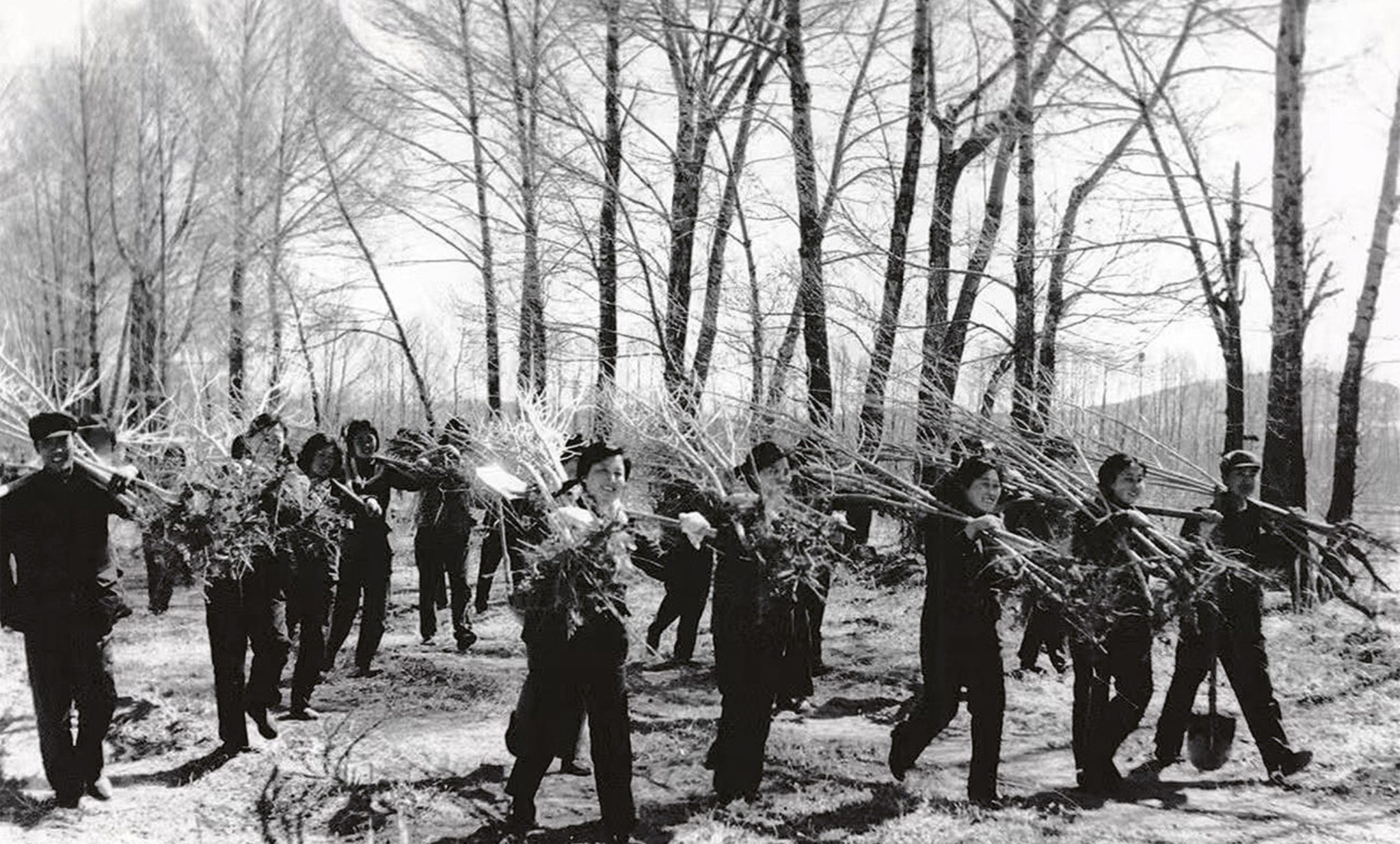
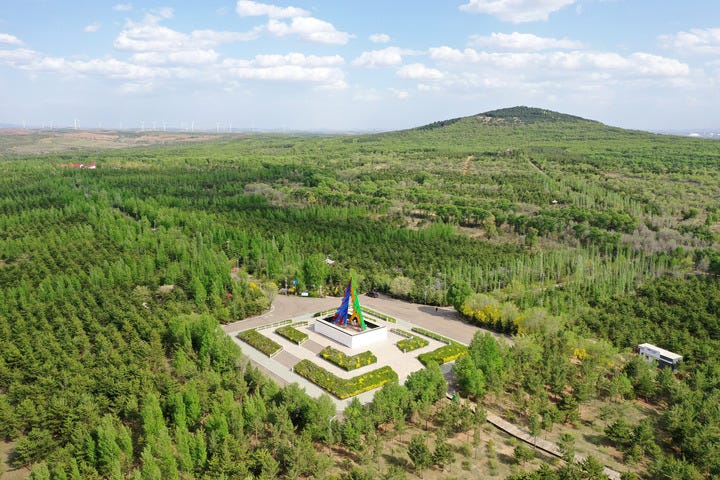
According to the article, 76 years later, Youyu has delivered a hard-core ecological answer: 90 percent of its desertified land has been effectively treated. The county, once pushed to the brink by wind and sand, has now become an important ecological barrier protecting the Beijing-Tianjin region. Every year, it reduces the amount of sediment flowing into the Yellow River by one million tonnes.
Today in Youyu, afforestation has developed into a mature green industry. For example, the county’s 300,000 mu of sea buckthorn forests have formed an industry with an annual output value of around 300 million yuan (about 44.2 million U.S. dollars).
China’s drone technology, which many of you are familiar with, has also found a role in Youyu. Today, drones are replacing manual labor in carrying saplings up the mountains. One drone can transport 120 saplings a day. The survival rate of Youyu’s afforestation has reached 92 percent, 18 times higher than in the early years after the founding of the People’s Republic of China.
There are many other interesting details in the article. If you are interested, you can read the full text with the help of a translation tool. I just want to add two more details.
First, a local journalist who has covered Shanxi for many years told me that while burning joss paper during the Qingming Festival, also known as Tomb-Sweeping Day, is a long-standing tradition across much of China, today, people in Youyu commemorate their ancestors by offering flowers instead of burning paper in order to protect the forests and the environment. Environmentally friendly forms of remembrance like this are, of course, not unique to China — I have encountered similar practices elsewhere in the world.
Second, he told me on that, according to the Youyu County Gazetteer, the county had just over 30 bird species in the 1980s. Today, that number has grown to more than 160, making Youyu a popular destination for birdwatchers.
In summarizing the view of governance performance represented by the “Youyu Spirit,” the article said:
True political achievement is not only about how many “highlights” an official creates during his or her term, but more importantly about how much foundation is left for future development. Seventy-six years. Twenty-two county Party secretaries. 130 million trees. Behind these numbers is a view of governance performance that goes beyond the individual, beyond the term of office, and beyond immediate interests. Local officials in Youyu often say: “Those who plant trees may not see the day when the trees become a forest, but they cannot refuse to plant them just because they may not see that day.”
The Youyu Spirit reminded me of the long-termism that is so often discussed today. This kind of trade-off is in fact not easy, because people sometimes tend to choose things that are beneficial to themselves in the short term, or pursue novelty in order to distinguish themselves from their predecessors. For that reason, the story of Youyu is indeed impressive.
I didn’t want to make this article too long, so I chose to focus on just this one case. I hope you found it helpful.
Great piece Jiang Jiang! People in the West often focus on "China Speed" but not often enough on China's long view. With a history of thousands of years, China's scale is different than most countries. These days many people in US are crowing about the 250th anniversary but compared to China's history, it's the mere blink of an eye. While some in US focus on "drill, baby, drill", the article shows New China, the CPC and its cadres have the Earth's environment and its protection written into it genetic code. A decade ago China had some of the most polluted places on the planet, but no longer. From having lived and choked through Beijing's 2013 "Airpocalypse" when pollution was 20-25 times WHO limits to today being in the "good to moderate" rate, its places like Youyu that illustrate why this transformation occurred.
Great post. I spent the past few weeks taking trains across Shandong, and between Beijing and Shanghai, and marveling at how green the countryside has become in recent years. There are so many trees! I looked it up: 66 billion trees have been planted since 1978 and there are plans to plant 34 billion more by the mid-21st century. I also recalled, as I whipped past the trees at 300 km an hour and sipped the Starbucks iced latte the train attendant had given me, that when I first took trains across China in the 1980s, the attendants served food in styrofoam containers and then gathered them all up in plastic bags and threw them out the window as the train chugged through the brown, often littered, countryside! Times have changed...